Monday, August 03

Mwonzora Kudira Jecha Declares Planned July 31 Protest Will Be A Huge Failure

The MDC-T secretary general, Douglas Mwonzora, has laughed off the planned July 31 protest against the deteriorating economy saying it will be a big flop as no person in their right mind will waste their time going into the streets, a strategy which he says has proven to be a failure over the years.

Mwonzora said his party will not be participating in the protests as they have bigger issues to attend to among them, their congress.

He said he was willing to bet his last cent that no protest will be done on July 31. “I can bet you my last cent that no one will attend the demonstrations. It will be a huge flop. The MDC-T will not be a part of the protests because we are busy preparing for our congress.

“On the day of the protests, is when we are supposed to have our congress. Those who want to go for the protests they are free to do so because this is a democracy,” said Mwonzora.

His statement comes at a time when the government is accusing the Nelson Chamisa led MDC Alliance of planning to use violence to topple a constitutionally elected government despite the fact that the protest was not called for by Chamisa Recently, the Zanu PF acting national spokesperson Patrick Chinamasa lashed out at Chamisa and his party of being used by the West to effect regime change.

Though the conveners of the protests have made it clear that they will be peaceful, Chinamasa said that they will not watch as lawlessness takes over the streets, threatening to unleash the full wrath of the law on all those found wanting. One of the conveners, Transform Zimbabwe (TZ) leader Jacob Ngarivhume, has since been arrested and remanded in custody to August 6 on inciting public violence charges.
Ngarivhume has been arrested together with journalist Hopewell Chin’ono who has been on the forefront exposing corruption by President Mnangagwa’s cabinet.

Mwonzora has courted public scorn after he has grown soft towards Zanu PF and fiery against fellow opposition members.

Related Story 

Douglas Mwonzora suffers major blow

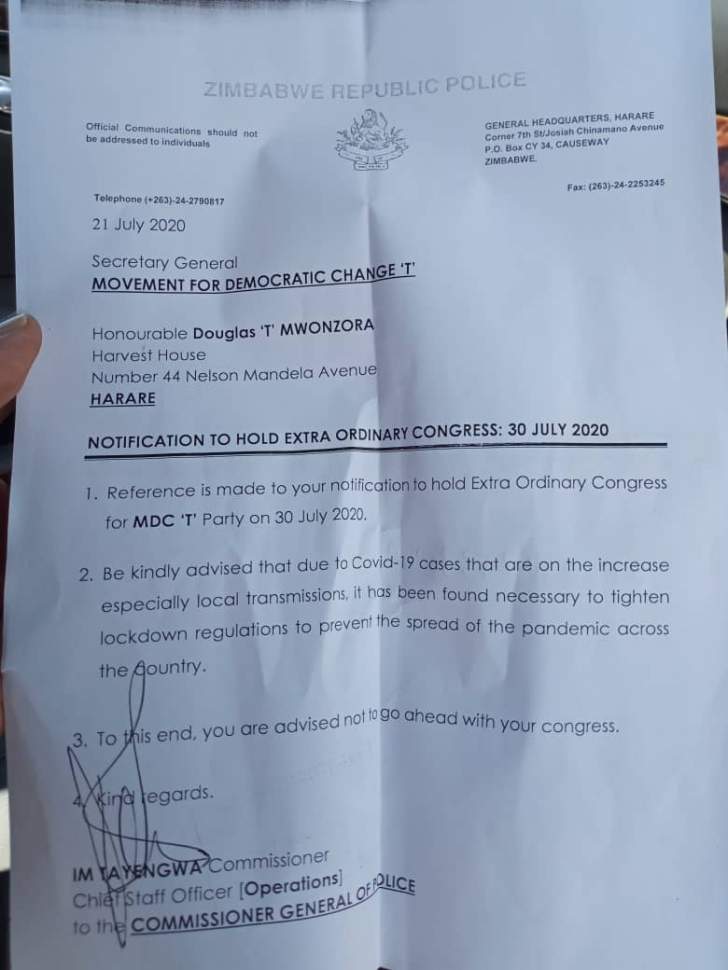
Acting MDC-T Secretary-General Douglas Mwonzora was dealt a blow by the Zimbabwe Republic Police after they turned down his request to hold an extra-ordinary Congress on Thursday.

In a letter seen by this publication, police said, "Be kindly advised that due to COVID-19 cases that are on the increase especially local transmissions. It has been found necessary to tighten lockdown regulations to prevent the spread of the pandemic across the country.

"To this end, you are advised not to go ahead with your congress.

MDC-T sources who spoke to this publication said the party's standing committee had tasked Morgen Komichi as the convenor of the Congress to approach the law enforcement agents for a clearance.

"Police turned down our request and then Mwonzora cunningly and nicodemuosly followed up that with a secret letter to the police proposing decentralized congresses with an average of 38 delegates each province." The source said.
 

  • Share:

Info News

Best High-Yield Savings Accounts for 2026

A savings account is one of the simplest financial tools you can use, but not all savings accounts are equal. Traditional savings accounts at large banks often pay very low interest, while high-yield savings accounts may offer much better returns on your cash.

A high-yield savings account can be a smart place to keep emergency savings, short-term goals, home down payment money, vacation funds, tax savings, or cash you do not want to invest in the stock market.

Unlike stocks or crypto, savings accounts are designed for stability and liquidity. Your money is accessible, usually insured when held at an eligible bank or credit union, and can earn interest while it sits safely.

This guide explains how high-yield savings accounts work, what to compare before opening one, how interest is calculated, and how to choose the best option for 2026.


What Is a High-Yield Savings Account?

A high-yield savings account is a deposit account that pays a higher interest rate than a traditional savings account.

Many high-yield savings accounts are offered by online banks, credit unions, fintech banking platforms, and digital divisions of larger financial institutions.

These accounts are commonly used for:

Emergency funds
Short-term savings
Home down payments
Car purchases
Travel savings
Wedding savings
Tax reserves
Business cash reserves
Temporary storage for investment cash

The main benefit is simple: your money can earn more interest while remaining easier to access than many long-term investments.


How High-Yield Savings Accounts Work

A high-yield savings account works like a normal savings account, but with a better interest rate.

You deposit money into the account. The bank pays interest based on the account’s annual percentage yield, often called APY. Interest may compound daily, monthly, or on another schedule depending on the bank.

You can usually move money by:

Electronic bank transfer
Direct deposit
Mobile check deposit
Wire transfer
ATM withdrawal if supported
Transfer to linked checking account

Some accounts may limit certain types of withdrawals or transfers, while others offer more flexibility.


APY vs Interest Rate

When comparing savings accounts, APY is the number that matters most.

The interest rate is the basic rate paid on your balance.

The APY shows how much you may earn over a year when compounding is included.

For example, two accounts may advertise similar interest rates, but the account with more frequent compounding may have a slightly higher APY.

When comparing accounts, use APY rather than only the interest rate.


Why High-Yield Savings Accounts Are Popular

High-yield savings accounts are popular because they offer a simple way to earn more on cash without taking stock market risk.

People use them because they provide:

Higher interest than traditional savings
Easy access to cash
Low risk
Simple setup
Useful emergency fund storage
FDIC or NCUA insurance when eligible
No need to lock money away for years
Automatic savings options
Online access
Separate accounts for different goals

For people who keep large balances in checking or low-interest savings, switching to a high-yield account can make a noticeable difference.


High-Yield Savings vs Traditional Savings

The biggest difference is the interest rate.

Traditional savings accounts at major banks may pay very little. High-yield savings accounts may pay significantly more, especially when interest rates are elevated.

Traditional savings accounts may offer:

Branch access
In-person service
Easy cash deposits
Lower APY
Familiar bank relationship

High-yield savings accounts may offer:

Higher APY
Online account opening
Lower fees
Faster digital tools
Limited branch access
Sometimes fewer cash deposit options

The best choice depends on whether you value branch access or higher earnings more.


High-Yield Savings vs Checking Account

A checking account is designed for daily spending. A savings account is designed for storing money.

Checking accounts are best for:

Paying bills
Debit card purchases
ATM withdrawals
Direct deposit
Everyday spending
Writing checks

High-yield savings accounts are best for:

Emergency funds
Short-term savings
Goal-based savings
Keeping money separate from spending
Earning interest

Many people use both: a checking account for daily transactions and a high-yield savings account for money they want to grow safely.


High-Yield Savings vs Money Market Account

A money market account is another type of deposit account that may pay interest. Some money market accounts include checks or debit cards, while savings accounts may have fewer transaction features.

High-yield savings accounts may be better if:

You want a simple savings tool
You do not need checks
You want easy online transfers
You are focused on APY

Money market accounts may be better if:

You want limited check-writing ability
You want debit card access
You keep larger balances
The APY is competitive

Always compare fees, minimum balances, and APY before choosing.


High-Yield Savings vs Certificate of Deposit

A certificate of deposit, or CD, usually locks your money for a set term in exchange for a fixed interest rate.

CDs may be good for money you do not need immediately. High-yield savings accounts are better for money you may need quickly.

High-yield savings account:

Flexible access
Variable rate
Good for emergency fund
No fixed term
Usually no early withdrawal penalty

Certificate of deposit:

Fixed term
Fixed rate
Early withdrawal penalty possible
Better for planned savings
Less flexible access

For emergency savings, a high-yield savings account is usually more practical than a CD.


Are High-Yield Savings Accounts Safe?

High-yield savings accounts can be safe when opened through a legitimate FDIC-insured bank or NCUA-insured credit union.

FDIC insurance generally protects eligible bank deposits up to applicable limits if the bank fails. NCUA insurance provides similar protection for eligible credit union deposits.

Before opening an account, confirm:

The bank or credit union is legitimate
The account is deposit-insured
Your balance stays within insurance limits
You understand whether a fintech platform partners with an insured bank
The account terms are clear

Do not assume every financial app has the same protections as a bank account. Always verify.


Can You Lose Money in a High-Yield Savings Account?

If the account is properly insured and your balance is within coverage limits, you generally do not lose principal because of market changes. Unlike stocks or mutual funds, savings account balances do not move up and down with the market.

However, you can lose money indirectly through:

Monthly fees
Excess transaction fees
Inflation reducing purchasing power
Fraud or scams
Balances above insurance limits
Using an uninsured platform
Account inactivity fees in rare cases

Choose a reputable institution and avoid unnecessary fees.


What to Look for in the Best High-Yield Savings Account

The best high-yield savings account is not always the one with the highest advertised APY. You should compare the full account.

Important features include:

APY
Monthly fees
Minimum opening deposit
Minimum balance requirement
FDIC or NCUA insurance
Transfer speed
Mobile app quality
Customer service
ATM access
Withdrawal limits
Linked account options
Direct deposit availability
Mobile check deposit
Rate history
Account security
Ease of opening
Hidden fees

A slightly lower APY may be worth it if the account has better service, faster transfers, and no frustrating restrictions.


Monthly Fees

A good high-yield savings account should have little or no monthly maintenance fee.

Fees can reduce your interest earnings. For example, if you earn $8 in interest but pay a $5 monthly fee, your real benefit is much smaller.

Look for accounts with:

No monthly maintenance fee
No minimum balance fee
No hidden account service fees
No unreasonable transfer fees

Some banks waive fees if you maintain a minimum balance, but no-fee accounts are often better for most savers.


Minimum Balance Requirements

Some high-yield accounts require a minimum balance to open the account or earn the highest APY.

Examples:

$0 minimum opening deposit
$100 minimum to earn interest
$1,000 minimum for top APY
$10,000 minimum for premium tier

Be careful with tiered rates. Some banks advertise a high APY that only applies to certain balances or promotional periods.

Read the account details before opening.


Variable Interest Rates

Most high-yield savings accounts have variable rates. That means the APY can change over time.

The bank may raise or lower the rate based on market conditions, competition, and internal pricing decisions.

A high APY today is not guaranteed forever.

That is why it is smart to periodically review your account and compare it with other options.


Promotional APYs

Some banks offer promotional rates to attract new customers. These rates may expire after a few months.

Before opening an account based on a promotional APY, ask:

How long does the rate last?
What will the rate be after the promotion?
Are there balance requirements?
Do I need direct deposit?
Are there monthly fees?
Is there a bonus requirement?
Can the bank change the rate anytime?

Promotional offers can be useful, but only if the long-term account still works for you.


How Much Can You Earn?

Your earnings depend on your balance, APY, and how long the money stays in the account.

Example:

If you keep $10,000 in a high-yield savings account earning 4% APY, you may earn about $400 in a year before taxes.

If the same money sits in a traditional savings account earning almost nothing, you may earn very little.

The higher your balance, the bigger the difference.

High-yield savings accounts are especially useful for people holding emergency funds or large short-term savings.


Taxes on Savings Account Interest

Interest earned from a savings account is usually taxable income.

Your bank may send a tax form if you earn enough interest during the year. Even if you do not receive a form, the interest may still need to be reported.

Tax rules depend on your situation, so speak with a tax professional if you are unsure.


Best Uses for a High-Yield Savings Account

A high-yield savings account is best for money you want to keep safe and accessible.

Good uses include:

Emergency fund
Home down payment
Car down payment
Vacation savings
Medical expense fund
Insurance deductible fund
Property tax savings
Wedding fund
Tuition savings
Short-term business savings
Freelancer tax savings
Home repair fund
Moving expenses

It is usually not the best place for long-term retirement investing because stock and bond investments may offer higher long-term growth, though with more risk.


Emergency Fund Strategy

One of the best uses for a high-yield savings account is an emergency fund.

An emergency fund can help cover:

Job loss
Medical bills
Car repairs
Home repairs
Unexpected travel
Insurance deductibles
Temporary income disruption

Many financial planners suggest building enough emergency savings to cover several months of essential expenses. The exact amount depends on your income stability, family size, debt, health needs, and job security.

A high-yield savings account keeps emergency money separate from daily spending while still accessible.


Goal-Based Savings

Some banks allow you to create separate savings buckets or subaccounts. This can help you organize money by goal.

Examples:

Emergency fund
Vacation
Christmas
Car repairs
Home repairs
Taxes
Insurance
College savings
New business fund

Goal-based savings can reduce the temptation to spend money meant for something important.


Should You Keep All Your Cash in One Account?

Keeping money in one high-yield savings account is simple, but some people prefer multiple accounts for organization.

You may use one account for emergency savings and another for short-term goals.

However, avoid overcomplicating your system. Too many accounts can become hard to track.

Also remember deposit insurance limits. If your cash balance is very large, you may need to spread money across institutions to stay within coverage limits.


Online Banks vs Traditional Banks

Many online banks offer higher APYs because they have lower overhead than banks with large branch networks.

Online banks may be good if you are comfortable with:

Mobile banking
Electronic transfers
Online customer service
No physical branch
Direct deposit
Remote account opening

Traditional banks may be better if you need:

Cash deposits
In-person service
Notary services
Safe deposit boxes
Local banker relationship
Immediate branch support

Some people keep checking at a local bank and savings at an online bank.


How to Open a High-Yield Savings Account

Opening an account is usually simple.

You may need:

Name
Address
Date of birth
Social Security number or tax ID
Government ID
Email address
Phone number
Employment information
Funding account
Initial deposit if required

Steps:

Compare accounts
Verify insurance
Review fees and APY
Submit application
Link external bank account
Transfer funds
Set up automatic savings
Monitor rate and statements

Make sure the website is legitimate before entering personal information.


How to Maximize Your Savings

To get the most value from a high-yield savings account:

Set up automatic transfers
Keep emergency savings separate
Compare APYs regularly
Avoid monthly fees
Keep enough in checking for bills
Use savings buckets
Deposit windfalls
Avoid unnecessary withdrawals
Review account terms
Keep balances within insurance limits
Use strong passwords and two-factor authentication

Small habits can build significant savings over time.


Common Mistakes to Avoid

Avoid these mistakes when choosing or using a high-yield savings account:

Opening an account based only on APY
Ignoring monthly fees
Not checking insurance coverage
Using an unfamiliar app without research
Keeping too much in checking
Not setting savings goals
Forgetting taxes on interest
Falling for fake bank websites
Not reading withdrawal rules
Moving money too often for tiny rate differences
Keeping balances above insurance limits

The best account is one that helps you save consistently and safely.


High-Yield Savings for Business Owners

Business owners may also benefit from high-yield savings accounts, especially for cash reserves.

A business may use high-yield savings for:

Tax reserves
Payroll reserves
Emergency operating fund
Equipment replacement
Insurance deductibles
Seasonal cash flow
Future expansion
Vendor payments

Business owners should make sure the account is designed for business use if the funds belong to the business.

Mixing personal and business funds can create accounting and tax problems.


High-Yield Savings for Retirees

Retirees may use high-yield savings accounts for short-term cash needs.

This can include:

Monthly spending reserves
Medical expenses
Travel funds
Home maintenance
Emergency cash
Required tax payments
Income bridge before Social Security or pension payments

Retirees often need a balance between safety, income, and liquidity. A high-yield savings account can be useful for the cash portion of a retirement plan.


Final Thoughts

A high-yield savings account is one of the easiest ways to make your cash work harder without taking major investment risk. It can be a smart choice for emergency funds, short-term goals, down payments, taxes, and money you need to keep accessible.

The best account should offer a competitive APY, no monthly fees, strong deposit insurance, easy transfers, good customer service, and clear terms.

Before opening an account, compare more than just the advertised rate. Look at fees, minimum balances, transfer rules, mobile tools, and whether the institution is legitimate and insured.

A high-yield savings account will not make you rich overnight, but it can help you earn more on money you already have while keeping your financial goals organized and protected.


FAQ

What is a high-yield savings account?

A high-yield savings account is a savings account that pays a higher APY than many traditional savings accounts.

Are high-yield savings accounts safe?

They can be safe when opened through an FDIC-insured bank or NCUA-insured credit union and kept within insurance limits.

Can the APY change?

Yes. Most high-yield savings accounts have variable rates that can rise or fall over time.

Is a high-yield savings account good for an emergency fund?

Yes. It is one of the best places for emergency savings because the money can earn interest while staying accessible.

Do high-yield savings accounts have fees?

Some do, but many online high-yield savings accounts have no monthly maintenance fee. Always check the terms.

Do I pay taxes on savings interest?

Usually yes. Savings account interest is generally taxable income.

Is a high-yield savings account better than a CD?

It depends. A savings account is more flexible, while a CD may offer a fixed rate but can lock your money for a set term.

How much money should I keep in high-yield savings?

Keep money you may need in the short term, such as emergency funds, planned expenses, and cash reserves. Long-term retirement money may need a broader investment strategy.

Best Business Credit Cards for Small Business Owners

A business credit card can be a useful financial tool for small business owners. It can help separate personal and business expenses, build business credit, track spending, manage cash flow, and earn rewards on everyday purchases.

rnrn

The best business credit card depends on how your business spends money. Some cards offer cash back on office supplies, fuel, internet, phone service, shipping, restaurants, or travel. Others offer flat-rate rewards on all purchases. If your spending is spread across many categories, a flat-rate card may be easier to manage.

rnrn

Before applying, compare the annual fee. A card with a high annual fee may still be worth it if the rewards, travel credits, or business benefits exceed the cost. However, for smaller businesses, a no-annual-fee card may be a better starting point.

rnrn

Interest rate is also important. If you pay your balance in full every month, the interest rate may not matter as much. But if you carry a balance, a high APR can quickly become expensive. Business owners who need financing should compare credit cards with other options such as business lines of credit or small business loans.

rnrn

Some business credit cards offer employee cards. This can make it easier to control spending and track purchases by employee. Look for cards that allow spending limits, alerts, and category controls.

rnrn

Rewards can be valuable, but they should not encourage unnecessary spending. A good rule is to choose a card that rewards expenses you already have. For example, if your business spends heavily on advertising, a card with bonus rewards for digital ad purchases may be useful.

rnrn

Business credit cards may also include benefits such as purchase protection, extended warranties, travel insurance, rental car coverage, and expense management tools. These features can save money when used properly.

rnrn

To improve approval chances, check your credit score, business revenue, and existing debt before applying. Many business cards require a personal guarantee, meaning the owner may be responsible for repayment if the business cannot pay.

rnrn

A business credit card should support your financial system, not replace responsible budgeting. Track expenses monthly, pay on time, and avoid mixing personal purchases with business transactions.

rnrn

When used wisely, a business credit card can help small business owners improve organization, earn rewards, and manage short-term expenses more effectively.

rn