Wednesday, September 09

True Love -Tinashe Maphosa Maybe Jobless After Leaving His Job Without Permission To Go & Mary Mai TT

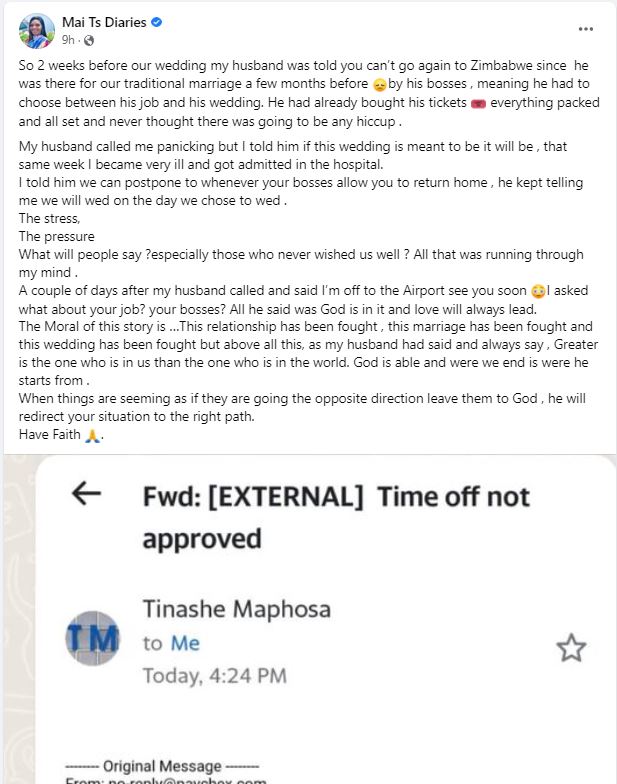
According to a post  by Mai TT on her Facebook her Husband Tinashe Maphosa was denied permission to come to Zimbabwe and Mary the love of his life. Tinashe was not willing to disapoint his woman and may be jobless after leaving without permission. Mai TT posted the following.

So 2 weeks before our wedding my husband was told you can’t go again to Zimbabwe since  he was there for our traditional marriage a few months before 😞by his bosses , meaning he had to choose between his job and his wedding. He had already bought his tickets 🎟 everything packed and all set and never thought there was going to be any hiccup . 
My husband called me panicking but I told him if this wedding is meant to be it will be , that same week I became very ill and got admitted in the hospital.
I told him we can postpone to whenever your bosses allow you to return home , he kept telling me we will wed on the day we chose to wed . 
The stress,
The pressure 
What will people say ?especially those who never wished us well ? All that was running through my mind .
A couple of days after my husband called and said I’m off to the Airport see you soon 😳I asked what about your job? your bosses? All he said was God is in it and love will always lead.
The Moral of this story is …This relationship has been fought , this marriage has been fought and this wedding has been fought but above all this, as my husband had said and always say , Greater is the one who is in us than the one who is in the world. God is able and were we end is were he starts from . 
When things are seeming as if they are going the opposite direction leave them to God , he will redirect your situation to the right path.
Have Faith 🙏.

Related Story


Mai TT leaves husband Tinashe Maphosa in tears

COMEDIENNE and musician Felistas ‘Mai TT’ Murata’s vows left her husband Tinashe Maphosa in tears on Saturday.

She received a standing ovation from guests when she described Tinashe as her last destiny. She thanked him for wiping away her tears, restoring her dignity and comforting her and promised to be faithful until her death. Tinashe, fixing his eyes on Mai TT’s face while holding her left hand, could not hold back his tears as his bride spoke.

He removed his spectacles, wiped off his tears, looked at Mai TT and cried even more.

  • Share:

Info News

Medical Malpractice Lawyer: When You May Have a Case

Medical Malpractice Lawyer: When You May Have a Case

Patients trust doctors, nurses, and hospitals to provide safe care. Unfortunately, medical mistakes can happen. A medical malpractice lawyer helps patients who were harmed by negligence, misdiagnosis, surgical errors, medication mistakes, or poor hospital care.

Not every bad medical outcome is malpractice. To have a case, there usually must be evidence that a healthcare provider failed to meet the proper standard of care and caused harm.

Common Medical Malpractice Cases

Common cases include missed diagnosis, delayed diagnosis, surgical mistakes, birth injuries, anesthesia errors, medication errors, infections, and failure to treat. A hospital negligence attorney can review medical records and determine whether negligence may have occurred.

What Compensation May Include

A medical lawsuit may seek compensation for medical bills, future care, lost income, pain and suffering, disability, and reduced quality of life.

Final Thoughts

Medical malpractice cases are complex and require strong evidence. If you believe a doctor or hospital mistake caused serious harm, speaking with a medical malpractice lawyer can help you understand your options.

Term vs Whole Life Insurance: Compare Costs and Coverage

Life insurance can protect a family from financial hardship if a wage earner, caregiver, or business owner passes away. The challenge is choosing the right type of policy. Two of the most common options are term life insurance and whole life insurance. Both can provide a death benefit, but they work differently, cost differently, and fit different planning goals.

Term life insurance is designed to last for a specific period, such as 10, 20, or 30 years. If the insured person dies during the term and the policy is active, the beneficiary receives the death benefit. If the term ends and the policy is not renewed or converted, coverage ends. Because term life does not usually build cash value, it is often more affordable than permanent life insurance for the same death benefit.

Term life can make sense when the main need is temporary protection. Parents may choose a term that lasts until children are grown, a mortgage is paid down, or college costs are no longer a concern. Business partners may use term life to support a buy-sell agreement during key growth years. A family with a tight budget may choose term insurance because it can provide a larger death benefit for a lower premium.

Whole life insurance is a type of permanent life insurance. It is designed to last for the insured person's lifetime as long as required premiums are paid. Whole life policies can build cash value over time. The cash value may be borrowed against or accessed under certain conditions, but loans and withdrawals can reduce the death benefit and may have tax consequences. Whole life premiums are usually much higher than term life premiums for the same initial death benefit.

Whole life can make sense for people who want lifetime coverage, predictable premiums, estate planning support, or a policy that includes cash value. It may also appeal to people who have already built a strong emergency fund, retirement savings, and basic protection, and who want another long-term planning tool. However, it is not automatically better simply because it lasts longer.

The right choice depends on the purpose of the coverage. If the goal is replacing income while children are young, covering a mortgage, or protecting a spouse during working years, term life may be enough. If the goal is lifetime estate liquidity, legacy planning, or long-term coverage that does not expire, whole life may be worth comparing.

Premiums should be reviewed carefully. A policy is only useful if you can keep it active. Buying an expensive permanent policy and later canceling it can be costly. Before choosing whole life, compare how the same dollars could be used for term coverage, retirement contributions, debt payoff, emergency savings, or other goals. This is not an either-or decision for everyone; some people use term life for large temporary needs and a smaller permanent policy for lifelong needs.

Underwriting is another factor. Insurers may review age, health history, medication, family history, lifestyle, driving record, occupation, hobbies, and sometimes medical exam results. Younger and healthier applicants often qualify for lower premiums, but each company evaluates risk differently. If you have a medical condition, an independent broker may help compare multiple insurers.

When comparing quotes, look beyond the premium. Ask whether the policy is level term or renewable term, whether it can be converted to permanent coverage, how long the premium is guaranteed, whether riders are included, and what happens if payments are missed. For whole life, ask for an in-force illustration, guaranteed values, non-guaranteed assumptions, surrender charges, loan interest, and how dividends are handled if applicable.

Common riders include waiver of premium, accelerated death benefit, child term rider, and guaranteed insurability. Riders can add flexibility, but they can also increase cost. Only add riders that solve a clear need.

Life insurance is not just a product; it is a financial safety plan. Start by estimating how much money your family would need for housing, debt, childcare, education, final expenses, and income replacement. Then compare policy types around that need. A licensed insurance professional or financial planner can help you evaluate options based on your state, budget, tax situation, and family goals.