Monday, June 01

Chiranga Mapenzi Baba Charamba Voti Munhu Wese Muzimbabwe Anoshandisa Musi Yangu Without My Permission Ndokudira Copyright

Chiranga Mapenzi Baba Charamba Voti Munhu Wese Muzimbabwe Anoshandisa Musi Yangu Without My Permission Ndokudira Copyright.


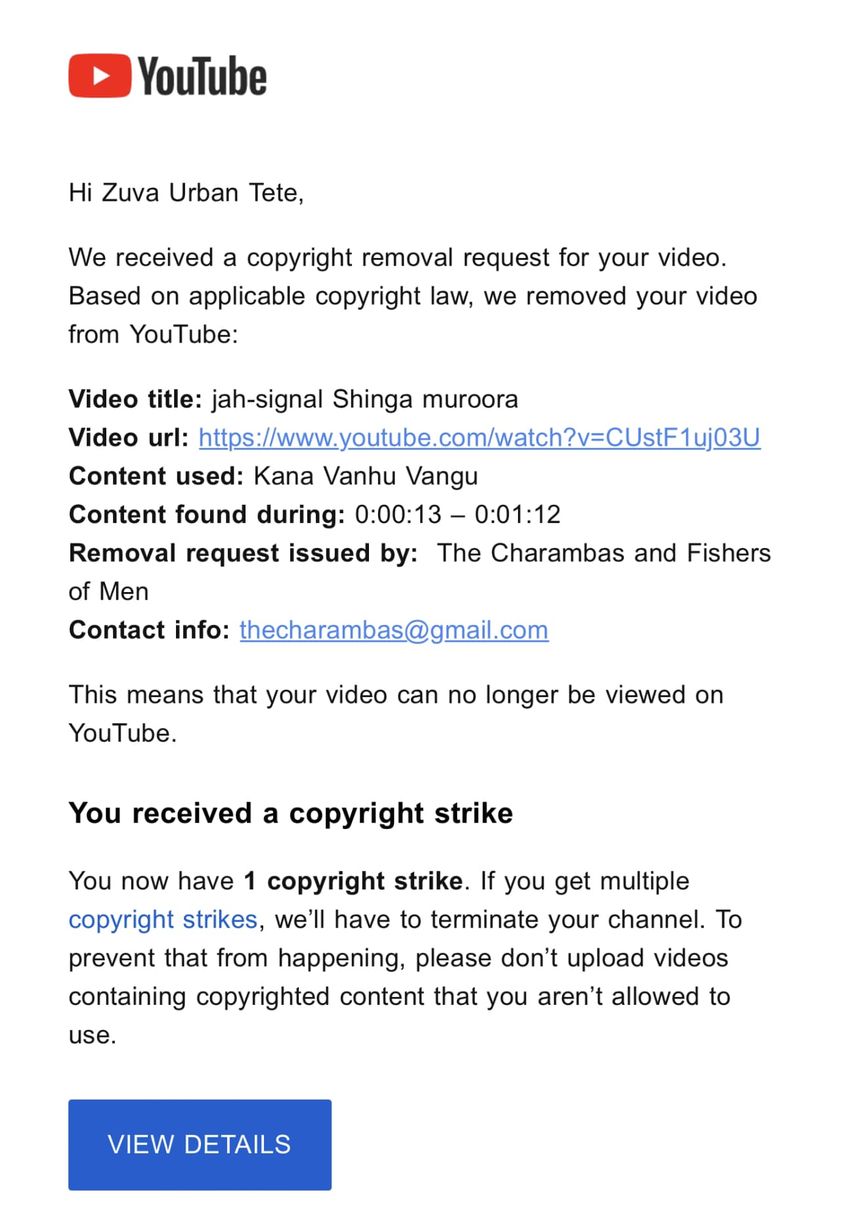
The removal of Jah Signal's 'Sweetie' video from YouTube due to a copyright claim by Charles Charamba ignites a debate on ethics, morality, and intellectual property rights in the music industry. This incident highlights the importance of balancing artistic freedom and respect for original creators.


In the dynamic world of music, where melodies intertwine with the fabric of culture, a recent incident has sparked widespread discussion on the delicate balance between artistic inspiration and intellectual property rights. At the heart of this discourse is the Zimdancehall sensation Jah Signal, whose 'Sweetie' music video, a crowd favorite that soared to over six million views since its 2018 release, found itself in the eye of a copyright storm. The video's removal from YouTube, instigated by a claim from gospel musician Charles Charamba, marks a pivotal chapter in the ongoing narrative of copyright in the digital age.


The Charambas, led by Charles and his wife Victoria, have been vocal about their disapproval, labeling the remix as blasphemous and in conflict with their moral beliefs. Their stance underscores the complex relationship between artistic freedom and the respect for original creators' rights. Furthermore, the incident sheds light on the broader implications for artists who navigate the fine line between inspiration and infringement in their creative processes. Jah Signal's public apology to the Charambas, while a gesture of goodwill, also serves as a cautionary tale for the music industry at large.


  • Share:

Info News

Divorce Attorney Near Me: How To Protect Yourself Before Filing

Divorce affects your money, home, children, retirement, and future. Searching for a divorce attorney near me can help you understand your rights before making major decisions.

rnrn

Before filing, gather financial records such as tax returns, bank statements, mortgage documents, retirement accounts, credit card bills, loan records, and pay stubs.

rnrn

If children are involved, custody and parenting time will be major issues. Courts usually focus on the child’s best interests. A lawyer can help create a parenting plan that addresses school, holidays, transportation, and decision-making.

rnrn

Property division depends on state law. Some states divide property equally, while others divide it fairly based on the circumstances.

rnrn

Avoid making emotional financial decisions during divorce. Do not empty accounts, hide assets, or ignore court orders.

rnrn

A divorce lawyer can explain your options, file paperwork, negotiate settlement terms, and represent you in court if needed.

rnrn

The earlier you get legal advice, the better prepared you may be.

rn

Can Credit Repair Companies Really Remove Collections?

Credit repair advertisements are everywhere.

rnrn

“Boost your credit score fast.”

rnrn

“Remove collections instantly.”

rnrn

“Fix bad credit now.”

rnrn

Sounds amazing, right?

rnrn

But many people eventually wonder something important.

rnrn

Can credit repair companies really remove collections?

rnrn

The answer is more complicated than most advertisements make it seem.

rnrn

Some collection accounts can be challenged successfully. Others remain permanently difficult to remove.

rnrn

Understanding how the process actually works can save you money, stress, and unrealistic expectations.

rnrn

What Collection Accounts Do to Your Credit Score

rnrn

Collections can seriously damage credit scores.

rnrn

Especially when accounts remain unpaid.

rnrn

Lenders often see collections as signs of financial risk.

rnrn

That may affect:

rnrn
    rn
  • Loan approvals
  • rn
  • Mortgage applications
  • rn
  • Car financing
  • rn
  • Credit card offers
  • rn
  • Insurance pricing
  • rn
  • Apartment applications
  • rn
rnrn

Even small collections can create major problems.

rnrn

What Credit Repair Companies Actually Do

rnrn

Many people assume credit repair companies have special legal powers.

rnrn

They do not.

rnrn

Most legitimate companies simply:

rnrn
    rn
  • Review credit reports
  • rn
  • Identify inaccurate information
  • rn
  • Dispute questionable accounts
  • rn
  • Communicate with credit bureaus
  • rn
  • Negotiate with creditors
  • rn
rnrn

Consumers can legally perform many of these steps themselves.

rnrn

That surprises a lot of people.

rnrn

When Collection Accounts Can Be Removed

rnrn

This is the part many companies avoid explaining clearly.

rnrn

Collections usually get removed only under specific situations.

rnrn

Incorrect Information

rnrn

If a collection contains inaccurate details, it may qualify for removal.

rnrn

Examples include:

rnrn
    rn
  • Wrong balances
  • rn
  • Incorrect dates
  • rn
  • Identity errors
  • rn
  • Duplicate accounts
  • rn
  • Fraudulent debts
  • rn
rnrn

Credit bureaus must investigate disputed information.

rnrn

Lack of Verification

rnrn

Debt collectors must verify debts when challenged.

rnrn

If they fail to provide proper documentation, accounts may sometimes be removed.

rnrn

But this does not happen automatically.

rnrn

Pay-for-Delete Agreements

rnrn

Some collection agencies agree to remove accounts after payment.

rnrn

This is called a pay-for-delete arrangement.

rnrn

Not all agencies allow this.

rnrn

And some major creditors refuse entirely.

rnrn

What Credit Repair Companies Cannot Legally Do

rnrn

This is extremely important.

rnrn

No legitimate company can legally remove accurate negative information simply because you want it gone.

rnrn

That includes:

rnrn
    rn
  • Legitimate late payments
  • rn
  • Valid collections
  • rn
  • Accurate defaults
  • rn
  • Real repossessions
  • rn
  • Correct bankruptcies
  • rn
rnrn

If a company guarantees instant deletion of accurate debts, that’s a major warning sign.

rnrn

Warning Signs of Credit Repair Scams

rnrn

The credit repair industry attracts many bad actors.

rnrn

Be cautious if companies:

rnrn
    rn
  • Demand large upfront fees
  • rn
  • Promise guaranteed score increases
  • rn
  • Tell you to create a new identity
  • rn
  • Instruct you to lie on applications
  • rn
  • Claim they can erase all bad credit
  • rn
rnrn

Those tactics may create legal problems.

rnrn

How Long Collections Stay on Credit Reports

rnrn

Most collections remain on credit reports for up to seven years.

rnrn

However, their impact may decrease over time.

rnrn

Newer collections typically damage scores more heavily than older ones.

rnrn

Paying collections may also improve lending opportunities in some situations.

rnrn

DIY Credit Repair vs Hiring Professionals

rnrn

Some people successfully dispute collections themselves.

rnrn

Others prefer professional assistance because the process becomes time-consuming.

rnrn

A good credit repair company may help organize disputes and communication more efficiently.

rnrn

But consumers should understand what they are paying for.

rnrn

Other Ways to Improve Credit Faster

rnrn

Removing collections is only one piece of the puzzle.

rnrn

Strong credit improvement strategies often include:

rnrn
    rn
  • Making on-time payments
  • rn
  • Lowering credit card balances
  • rn
  • Avoiding unnecessary hard inquiries
  • rn
  • Keeping older accounts open
  • rn
  • Monitoring credit reports regularly
  • rn
rnrn

Consistent habits matter more than quick tricks.

rnrn

Why Credit Repair Keywords Have High CPC

rnrn

Credit repair leads are extremely valuable to:

rnrn
    rn
  • Financial service companies
  • rn
  • Lenders
  • rn
  • Debt consolidation firms
  • rn
  • Credit monitoring providers
  • rn
  • Personal finance platforms
  • rn
rnrn

That strong commercial intent drives aggressive advertising competition.

rnrn

Final Takeaway

rnrn

Credit repair companies can sometimes help remove collection accounts, but only under specific circumstances.

rnrn

Accurate negative information usually cannot legally disappear overnight.

rnrn

The best results often come from realistic expectations, careful financial habits, and understanding your legal rights during the credit dispute process.

rnrn

If something sounds too good to be true in the credit repair industry, it usually is.

rnrn

FAQ

rnrn

Can paying a collection remove it from my credit report?

rnrn

Not automatically. Some agencies may agree to pay-for-delete arrangements, but many do not.

rnrn

Are credit repair companies legitimate?

rnrn

Some are legitimate, but consumers should research carefully because scams exist in the industry.

rnrn

How long do collections stay on credit reports?

rnrn

Most collections remain for up to seven years.

rnrn

Can I dispute collections myself?

rnrn

Yes. Consumers have the legal right to dispute inaccurate information directly with credit bureaus.

rnrn

Do paid collections still affect credit scores?

rnrn

They may still affect scores, though some scoring models weigh paid collections differently.

rn