Friday, August 07

Zuva Habane & SA Idols Judge Unathi Clash Over Selfie Snub

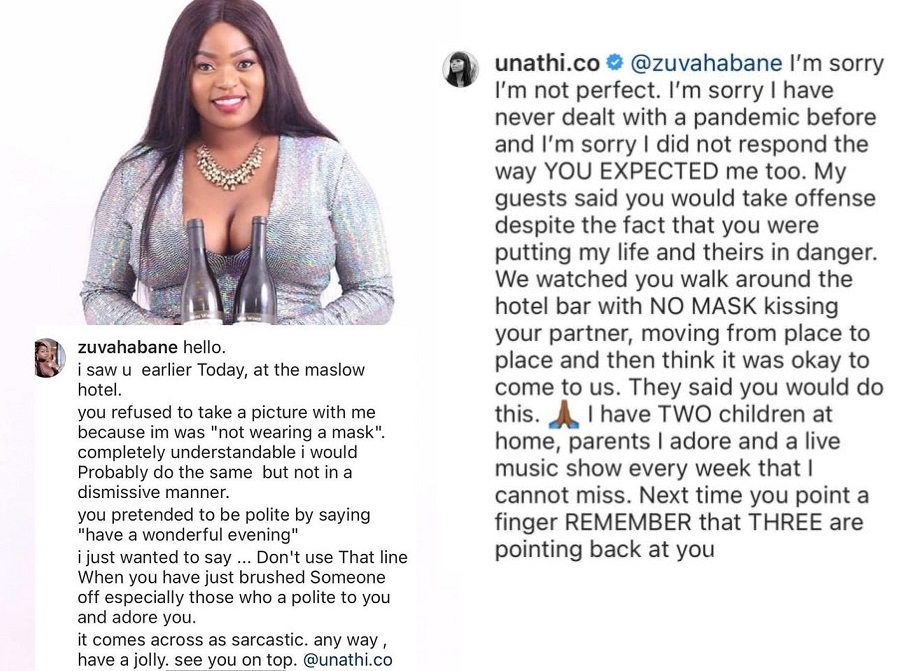
There was drama on social media last night after socialite Zuva Habane clashed with South Africa Idol’s judge Unathi over a selfie. Apparently, Zuva Habane was at a function to which Unathi and her friends were also in attendance. On noticing her fav celeb, Zuva decided to go and ask to take a selfie with her. However, it all went sour when Unathi denied her the selfie citing that she was not putting on her facemask when she approached her.

She further claimed that turned down the selfie request simply because Zuva was all lovey-dovey with her partner kissing and cuddling before she had the audacity of then coming to her without a face mask to ask to take a selfie with her. However, this did not seat well with Zuva Habane who then decided to post the incident on her social media platform..

Unathi Posted the following 

UNCOMFORTABLE TRUTH
Things have changed and they have changed forever and we will all react differently because of our personal journeys and responsibilities.

I am noticing an increased tension building with people I have never met who want to engage with me and get offended if I decline when they are not wearing masks in public places. This is the New norm and it is going to be like this for a while.

Daily, because I come from the EC, which is terribly affected we are receiving news of people dying. As I speak I must return there tomorrow to bury my gran. My friends are losing their parents, siblings and colleagues and this is hitting all of us HARD.

I guess this is my disclaimer........call me ANYTHING you want under the sun. If you’re NOT wearing a mask.......don’t expect ANYTHING from ME. I will not put my children or parents’ lives in danger. I imagine having to miss the live shows on Idols because I wasn’t vigilant. I can’t

MY TRUTH.

Zuva Responded 

sis you weren’t wearing a mask, No one was but That’s beside the point . I feel you handled Everything in a dismissive manner, Maybe you didn’t feel like it I have days like That too. I adore you hence I was polite I just didn’t know this other side of you. Be nice to everyone, Some of them even pray for you That’s all I’m saying, have a nice day”

  • Share:

Info News

Personal Injury Lawyer Questions Before Hiring

After an accident, choosing a personal injury lawyer can feel overwhelming. You may be dealing with medical appointments, missed work, insurance calls, vehicle repairs, pain, and uncertainty about what happens next. A lawyer can help with claim strategy, evidence, deadlines, negotiations, and litigation, but not every attorney is the right fit for every case.

The first question is experience. Ask whether the attorney has handled cases similar to yours. A car accident case is different from a trucking accident, medical malpractice claim, workplace third-party claim, defective product case, or premises liability case. Similar case experience can help the lawyer understand evidence, expert witnesses, insurance tactics, and likely challenges.

Next, ask who will actually handle the file. In some firms, the lawyer you meet may not be the person managing daily communication. Paralegals, case managers, associates, and investigators may all be involved. That is normal, but you should know who your main contact will be and how often you will receive updates.

Fees are important. Many personal injury lawyers work on a contingency fee, meaning they are paid a percentage of the recovery if money is obtained. Ask what percentage applies, whether it changes if a lawsuit is filed, and how case expenses are handled. Expenses may include filing fees, medical records, depositions, expert witnesses, investigation, and trial exhibits. Ask whether expenses are deducted before or after the attorney fee and whether you owe expenses if there is no recovery.

Ask about the strength and weakness of your case. A trustworthy lawyer should not promise a guaranteed result. They should discuss liability, damages, insurance limits, prior injuries, medical documentation, comparative fault, witness issues, and possible defenses. If a lawyer only tells you what you want to hear, be cautious.

Evidence can determine the outcome of a claim. Ask what evidence should be gathered immediately. This may include accident reports, photographs, video footage, witness statements, medical records, employer wage records, vehicle data, inspection records, maintenance records, or property incident reports. Some evidence can disappear quickly, so early action matters.

Medical treatment is another key topic. Personal injury claims often depend on documented injuries, treatment consistency, diagnosis, prognosis, and how the injury affects daily life. Follow medical advice and keep records of appointments, prescriptions, therapy, restrictions, and out-of-pocket expenses. Do not exaggerate, but do not minimize symptoms either.

Ask how the attorney evaluates settlement offers. A settlement should consider medical bills, future care, lost income, reduced earning capacity, pain and suffering, property damage, permanent impairment, and other legally recognized damages. The exact rules vary by state and case type. The attorney should explain the factors, not just give a quick number.

Timeline is another area to discuss. Some claims settle in months, while others take much longer, especially if injuries are serious or liability is disputed. A lawyer may recommend waiting until you reach maximum medical improvement before settlement so future medical needs are clearer. Settling too early can be risky because you usually release claims permanently.

Communication expectations should be clear. Ask how quickly calls or emails are returned, whether the firm uses a client portal, and what updates you will receive. A good lawyer-client relationship requires trust, responsiveness, and organized documentation.

You should also ask whether the lawyer is prepared to file a lawsuit if necessary. Many cases settle, but the willingness and ability to litigate can affect negotiation leverage. Ask about trial experience, recent results, and how the firm prepares cases.

This article is general information, not legal advice. Personal injury laws, deadlines, damages, and fault rules vary by state. Speak with a licensed attorney in your jurisdiction to understand your rights. The best lawyer for your case is someone with relevant experience, clear communication, transparent fees, and a realistic plan for proving your claim.

High Net Worth Divorce Lawyer: Protecting Assets, Businesses, and Retirement

high net worth divorce lawyer, high asset divorce attorney, complex divorce lawyer, business owner divorce, divorce asset protection, property division lawyer

rnrn

High Net Worth Divorce Lawyer: Complex Property Division

rnrn

A high net worth divorce can involve much more than dividing a house and checking account.

rnrn

These cases may include businesses, investment accounts, retirement plans, real estate, trusts, executive compensation, stock options, professional practices, tax issues, and hidden asset concerns.

rnrn

A high net worth divorce lawyer helps protect financial interests and build a strategy for complex property division.

rnrn

What Makes a Divorce High Net Worth?

rnrn

A divorce may be considered high net worth if it involves substantial assets, complex income, or valuable property.

rnrn

Examples include:

rnrn

Business ownership
rnMultiple homes
rnRental properties
rnInvestment portfolios
rnRetirement accounts
rnStock options
rnRestricted stock units
rnProfessional practices
rnTrusts
rnCrypto assets
rnLuxury assets
rnInheritance issues
rnHigh income
rnInternational assets

rnrn

These cases require careful financial analysis.

rnrn

Why Valuation Matters

rnrn

One of the biggest issues is determining what assets are worth.

rnrn

Assets that may need valuation include:

rnrn

Businesses
rnReal estate
rnPensions
rnProfessional practices
rnStock options
rnPrivate investments
rnArtwork
rnJewelry
rnCollectibles
rnIntellectual property
rnCryptocurrency

rnrn

A lawyer may work with financial experts, appraisers, forensic accountants, and tax professionals.

rnrn

Business Owner Divorce

rnrn

If one or both spouses own a business, divorce can become complicated.

rnrn

Questions may include:

rnrn

Is the business marital property?
rnWhat is the business worth?
rnDid the value increase during marriage?
rnIs income being underreported?
rnCan one spouse buy out the other?
rnWill business records be disclosed?
rnHow are retained earnings treated?
rnAre personal expenses being paid by the business?

rnrn

Business valuation can become one of the most contested parts of divorce.

rnrn

Hidden Assets in Divorce

rnrn

Some spouses try to hide or reduce assets before divorce.

rnrn

Warning signs may include:

rnrn

Sudden transfers
rnUnusual withdrawals
rnNew loans
rnChanged passwords
rnMissing statements
rnDelayed bonuses
rnOverpaid taxes
rnFake business expenses
rnCrypto transfers
rnAssets moved to relatives
rnUndervalued business interests

rnrn

A high net worth divorce lawyer may use discovery tools to request documents and trace money.

rnrn

Retirement and Investment Accounts

rnrn

Dividing retirement accounts may require special orders.

rnrn

Common accounts include:

rnrn

401(k)
rnIRA
rnPension
rn403(b)
rn457 plan
rnMilitary retirement
rnBrokerage accounts
rnDeferred compensation

rnrn

Some retirement divisions require a Qualified Domestic Relations Order, often called a QDRO.

rnrn

Mistakes can create tax problems or loss of benefits.

rnrn

Tax Issues in High Asset Divorce

rnrn

Divorce can affect taxes in major ways.

rnrn

Tax questions may include:

rnrn

Who claims children
rnCapital gains exposure
rnSale of home
rnAlimony tax treatment
rnBusiness tax liabilities
rnRetirement withdrawals
rnStock option taxation
rnCarryforward losses
rnFiling status
rnProperty transfer rules

rnrn

A divorce lawyer may coordinate with a CPA or tax attorney.

rnrn

Prenuptial and Postnuptial Agreements

rnrn

High net worth divorces often involve prenuptial or postnuptial agreements.

rnrn

A lawyer may review:

rnrn

Whether the agreement is valid
rnWhether disclosures were complete
rnWhether terms are enforceable
rnWhether circumstances changed
rnWhether there was pressure or lack of counsel

rnrn

Do not assume an agreement is automatically enforceable or invalid.

rnrn

Final Thoughts

rnrn

A high net worth divorce requires careful planning, financial investigation, and legal strategy.

rnrn

If your divorce involves a business, investments, real estate, retirement accounts, or complex income, do not rely on guesswork.

rnrn

The right lawyer can help protect your assets and avoid mistakes that may affect your financial future for decades.

rn