United-Kingdom based Zimbabwean nurse has been sentenced to two years probation and 100 hours of community service following an audacious attempt at insurance fraud. The nurse tried to claim almost £ 400,000. (US$ 554,000) by faking her husband’s death.
51-year-old Thuile Bhebhe claimed that her husband had died in Zimbabwe in August 2016 and attempted to get life insurance worth £397,153 from Aviva. She submitted fake documents, including a forged death certificate which showed that her husband had purportedly died in Nkayi, Matabeleland North. During an interview, she also claimed that she had attended the funeral.
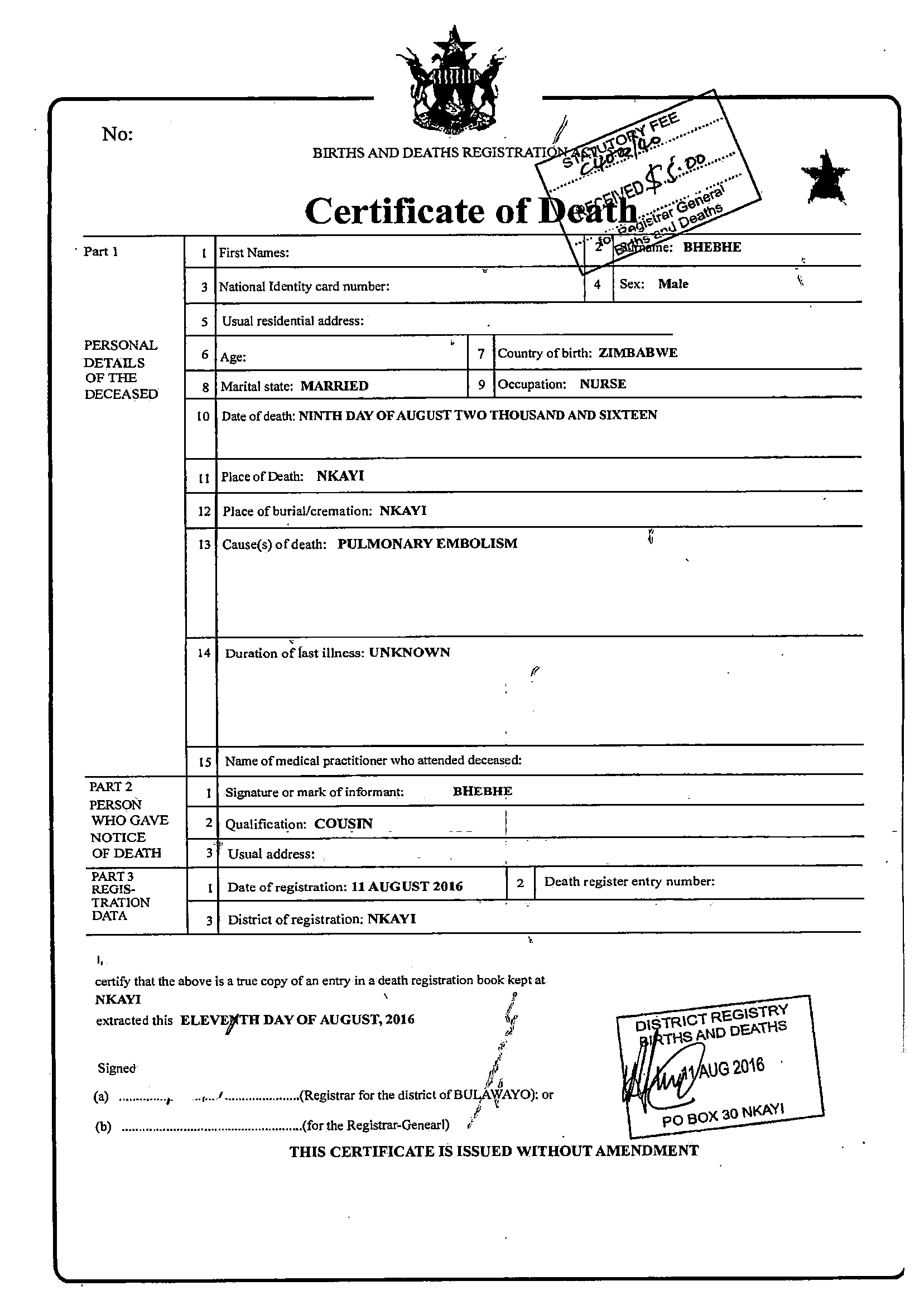
However, in her haste to claim the money, Bhebhe made errors on the paperwork. The discrepancies in the paperwork raised red flags at Aviva leading the insurance company to investigate the claim further.
According to the city of London Police investigators at Aviva discovered that Bhebhe’s husband was alive and well. The police went on to say that “simple checks” revealed that the husband who is also a nurse, had worked a long day shift at Charing Cross Hospital, on the day that he supposedly died thousands of kilometres away in rural Zimbabwe. After unearthing the fraudulent action, Aviva referred the case to the City of London Police’s Insurance Fraud Enforcement Department (IFED).
Bhebhe who had already previously pleaded guilty at the City of London Magistrates Court in November 2018 appeared at the Inner London Crown Court on 15 March 2021 for sentencing. She was sentenced to two years imprisonment. However, the two years were wholly suspended. She was also sentenced to 100 hours of community service, with a twenty-five-day Rehabilitation Activity Requirement.
Detective Constable James Rafiq, from the City of London Police’s Insurance Fraud Enforcement Department, said:
“Mrs Bhebhe tried to exploit Aviva and steal nearly £400,000 by shamelessly claiming her husband had died. Although she has shown remorse, these fraudulent actions have tainted years of commendable work as NHS nurses for both her and her husband.
“Thanks to Aviva’s diligence when initially reviewing the claim, and their swift action in referring it to IFED for further investigation, Mrs Bhebhe’s ridiculous lie was exposed and she has been rightly punished.”
Jacqueline Kerwood, Claims Governance Manager for Individual Protection at Aviva, said:
“This was a particularly audacious act of dishonesty by Mrs Bhebhe – in attempting to claim nearly £400,000 by falsely claiming her own husband’s death. Fortunately, it was quickly detected by our expert investigators, and we’re pleased to see justice has been done. This is also very good news for our genuine customers, who ultimately bear the cost of fraud through their premiums. In this case, however, it’s Mrs Bhebhe who will pay the cost for her crime.”
Info News
Space Exploration and the Search for Life Beyond Earth
Space exploration has fascinated humanity for generations, inspiring scientific discoveries and technological innovation. Governments and private companies are investing billions of dollars into missions designed to explore the Moon, Mars, and distant regions of the universe. Advances in rocket technology, satellite systems, and astronomy are expanding human understanding of space and the possibility of life beyond Earth.
rnrn
One major goal of modern space programs is establishing long-term human presence on other planets. Space agencies such as NASA and private companies are developing technologies that could allow astronauts to live and work on Mars in the future. Scientists believe Mars may contain evidence of ancient water systems and potentially microbial life forms that existed billions of years ago.
rnrn
Space exploration also contributes significantly to technological advancement on Earth. Satellite technology supports communication systems, weather forecasting, navigation services, and disaster management worldwide. Medical research conducted in space environments has also improved healthcare technologies and scientific understanding of human biology.
rnrn
However, space exploration faces major challenges including high costs, radiation exposure, and the difficulty of sustaining human life in extreme environments. Long-duration missions require advanced life support systems, reliable energy sources, and protection from cosmic radiation.
rnrn
Despite these challenges, interest in space exploration continues growing globally. Scientists believe future discoveries could provide valuable information about planetary systems, the origins of the universe, and the possibility of extraterrestrial life. Space exploration represents one of humanity’s greatest scientific and technological ambitions.
rn
Tax Law & IRS Debt Relief: Managing Financial Obligations
Tax law and IRS debt relief services help individuals resolve tax issues and reduce financial burdens. Many users search for solutions to manage tax debt and avoid penalties.
rnrn
Keywords such as “IRS debt relief” and “tax attorney near me” are high CPC due to urgency and complexity. Content should explain options like payment plans and legal representation.
rnrn
Providing clear, actionable advice can build trust and improve SEO performance. This niche attracts high-value traffic and strong advertiser competition.
rn


