Monday, June 01

Moana’s Burial Suspended Indefinitely As Court Struggles To Make Ruling

The dispute over how and where Michelle “Moana” Amuli will be buried looks set to establish a legal precedent in Zimbabwe to govern how such conflicts among relatives belonging to different faiths can be resolved in the fairest possible way.

The socialite and fitness trainer died in a car crash early this month, but her estranged father and mother desire different funeral ceremonies and different grave sites.

High Court judge Justice Pisirayi Kwenda now has to sort everything out and has made it clear that since disputes of this nature rarely spill into courts and local jurisprudence on the subject is very thin, he needs more time for a carefully thought out judgment involving important and fundamental issues for all parties.

The judgment is not yet ready,” Justice Kwenda said.

“I need more time to consider judgment. I will communicate with the lawyers when the ruling is done.”

The deceased’s father Mr Ishmael Amuli is pressing for a Muslim burial, while the mother Ms Yolander Kuvaoga wants her daughter buried under Christian rites.

Moana was burnt beyond recognition alongside Mozambican model Alisha Adams and Malawian businessman Limumba Karim in an accident, which also claimed the life of socialite Genius “Ginimbi” Kadungure on November 8.

All the other victims have since been buried, while the protracted dispute over Moana’s burial rages on.

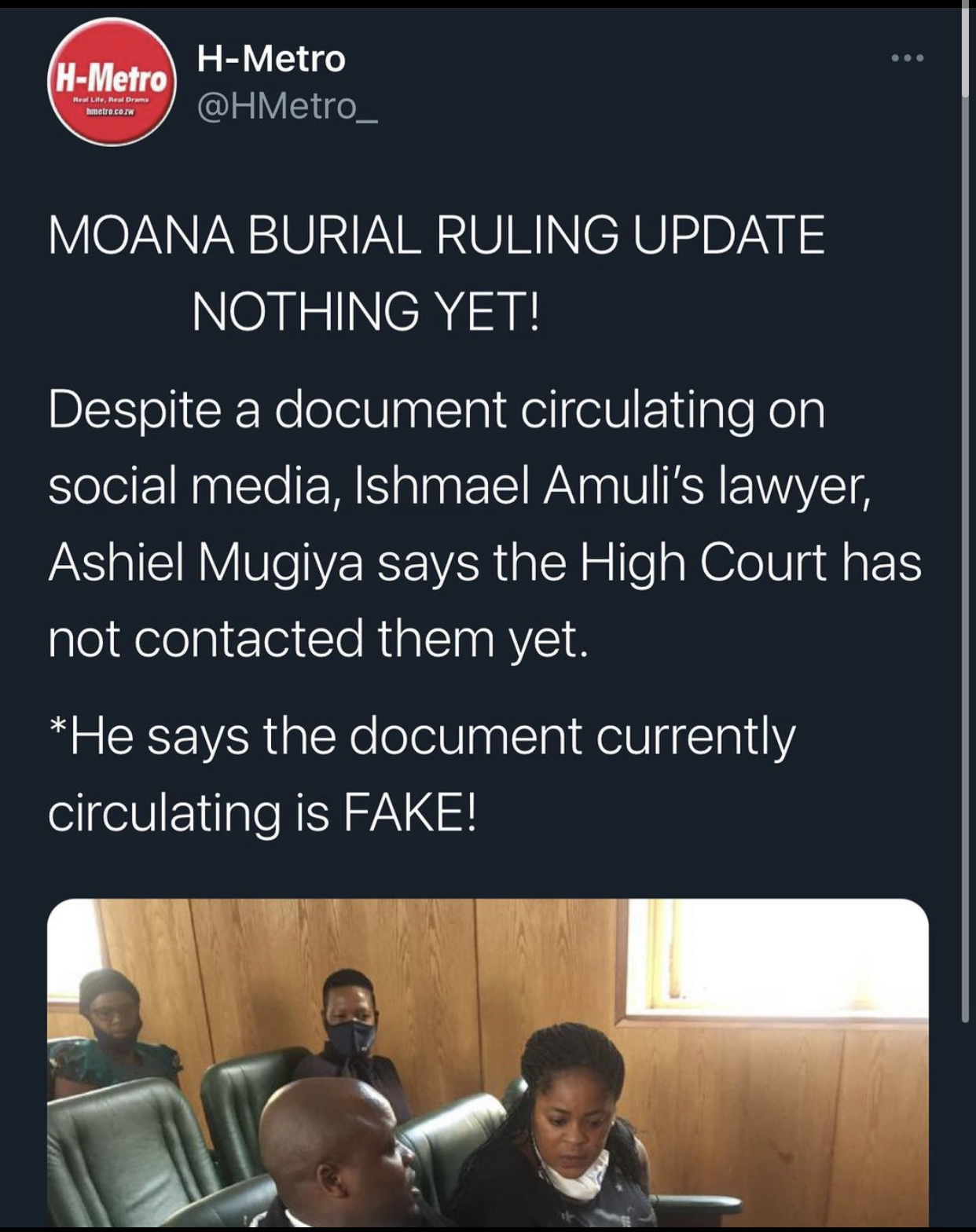
Speaking after the court proceedings, Mr Amuli’s lawyer Mr Arshiel Mugiya said they would wait for communication from the court as to when the judgment will be ready.

“Unfortunately, the judgment is not yet ready, so the judge explained that because the case is novel,” he said.

“No court has ever dealt with a dispute where a father and a mother are arguing as to how a child may be buried.”

Justice Kwenda still needed time to consider the submissions made by both parties and for him to make an informed decision which has the effect of shaping the country’s jurisprudence around this area of law.

“He has reserved judgment and he said that we will be told through his clerk as to when the judgment is ready,” he said.

“We are hoping that the communication comes soon, but for now we just have to wait.”

Ms Kuvaoga, represented by lawyer Mr Jerome Madondo, last week approached the High Court on an urgent basis seeking an interim interdict to stop the burial until the finalisation of the matter.

Mr Mugiya challenged the application, arguing that the court cannot nullify a burial order that was lawfully obtained.

  • Share:

Info News

First Offense DUI Lawyer: What Happens After a First DUI Charge?

first offense DUI lawyer, first DUI attorney, first DUI charge, first time DUI lawyer, DUI first offense penalties, drunk driving first offense

rnrn

First Offense DUI Lawyer: What Happens After a First DUI Charge?

rnrn

A first DUI arrest can be frightening, especially if you have never been in trouble before. You may worry about jail, losing your license, your job, your insurance, and whether you will have a permanent criminal record.

rnrn

A first offense DUI lawyer can explain what happens next and help you avoid mistakes that may make the situation worse.

rnrn

Even a first DUI can carry serious consequences. Do not assume the court will automatically go easy because it is your first arrest.

rnrn

Is a First DUI a Criminal Charge?

rnrn

In many states, a first DUI is a misdemeanor, but that does not mean it is minor.

rnrn

A conviction may lead to:

rnrn

Fines
rnCourt costs
rnProbation
rnAlcohol education classes
rnLicense suspension
rnIgnition interlock device
rnCommunity service
rnJail exposure
rnCriminal record
rnHigher insurance premiums

rnrn

Penalties vary by state and by facts such as blood alcohol level, accident involvement, refusal to test, injuries, minors in the vehicle, and prior history.

rnrn

What Happens After the Arrest?

rnrn

A first DUI case may involve two separate tracks.

rnrn

Criminal Court Case

rnrn

This is where the DUI charge is handled. The court may address guilt, innocence, plea options, sentencing, probation, and other penalties.

rnrn

Driver’s License Case

rnrn

The license issue may be handled separately through the motor vehicle agency or administrative hearing process.

rnrn

This is important because you may have a short deadline to request a license hearing.

rnrn

Why You Should Act Quickly

rnrn

After a DUI arrest, deadlines may come fast.

rnrn

You may need to:

rnrn

Request an administrative hearing
rnAppear in court
rnPreserve video evidence
rnObtain police reports
rnReview test results
rnEnroll in required programs
rnAvoid license suspension mistakes

rnrn

Missing a deadline can limit your options.

rnrn

Can a First DUI Be Dismissed?

rnrn

Sometimes charges are dismissed, reduced, or resolved in a different way, but it depends on the facts and the law.

rnrn

Possible defense issues include:

rnrn

Illegal traffic stop
rnNo probable cause for arrest
rnImproper field sobriety testing
rnBreath test problems
rnBlood test chain-of-custody issues
rnMedical conditions affecting results
rnOfficer procedure errors
rnLack of proof of impairment

rnrn

A lawyer must review the evidence before giving realistic guidance.

rnrn

What About Breath Test Results?

rnrn

Breath test evidence can be important, but it is not always perfect.

rnrn

A DUI lawyer may review:

rnrn

Machine calibration
rnMaintenance records
rnOfficer certification
rnObservation period
rnMouth alcohol issues
rnTesting procedure
rnTiming of the test
rnBreath sample quality

rnrn

The legal blood alcohol concentration limit is commonly .08 in many U.S. jurisdictions, but state law can vary and additional rules may apply for commercial drivers, underage drivers, and high-BAC cases. NHTSA provides national drunk-driving safety resources and state-focused impaired-driving guidance.

rnrn

What If You Refused a Breath or Blood Test?

rnrn

Refusal can create additional consequences, especially for your license.

rnrn

Many states have implied consent laws. That means drivers may face license penalties for refusing chemical testing after a lawful DUI arrest.

rnrn

A lawyer can help review whether the refusal was legally valid and what defenses may apply.

rnrn

Will You Need an Ignition Interlock?

rnrn

An ignition interlock device may be required in some DUI cases. NHTSA explains that an alcohol ignition interlock prevents a vehicle from starting or operating unless the driver provides a breath sample below a preset level, often used as a condition for driving after alcohol-related offenses.

rnrn

Rules vary by state, offense level, and court order.

rnrn

Can You Drive After a First DUI?

rnrn

Maybe, but it depends on your state, license status, administrative deadlines, and whether you qualify for restricted driving privileges.

rnrn

A lawyer can help you understand:

rnrn

Whether your license is suspended
rnWhether you can request a hearing
rnWhether temporary driving privileges apply
rnWhether you need an interlock
rnWhether you qualify for a hardship license

rnrn

Do not guess. Driving on a suspended license can create new charges.

rnrn

Final Thoughts

rnrn

A first DUI is serious, but it is also a situation where early action matters.

rnrn

A first offense DUI lawyer can review the stop, test results, police reports, license deadlines, and court options. The goal is to protect your rights and reduce avoidable damage to your future.

rn

Cybersecurity Threats in the Digital Age

Cybersecurity has become one of the most important concerns in the modern digital world. Businesses, governments, and individuals increasingly rely on online systems for communication, banking, shopping, and data storage. As technology advances, cybercriminals continue developing sophisticated methods to steal information, disrupt systems, and commit financial fraud.

rnrn

Common cybersecurity threats include phishing attacks, ransomware, identity theft, malware infections, and data breaches. Hackers often target businesses and individuals through deceptive emails, malicious websites, and weak passwords. Financial institutions, healthcare systems, and government agencies are especially vulnerable because they store sensitive personal and financial information.

rnrn

Organizations are investing heavily in cybersecurity systems to protect digital infrastructure and customer data. Firewalls, encryption technologies, antivirus software, and multi-factor authentication tools help reduce security risks. Employee training is also essential because human error remains one of the leading causes of cyber incidents.

rnrn

Artificial intelligence is increasingly being used to improve cybersecurity defense systems. AI-powered tools can monitor networks, detect unusual activity, and respond to threats faster than traditional methods. However, cybercriminals are also using advanced technology to launch more complex attacks, creating an ongoing digital security battle.

rnrn

Experts believe cybersecurity education and public awareness will become even more important as internet usage and digital transactions continue growing worldwide. Protecting personal information and online privacy remains essential in the rapidly evolving digital economy.

rn