Sunday, October 18

Mai TT Wants US$200,000 Defamation Damages From Evidence Chihera

Controversial social media personality and comedienne Mai Titi has demanded a massive US$200,000 in defamation damages from media personality Evidence Jiri who is better known as “Chihera” in social media circles.

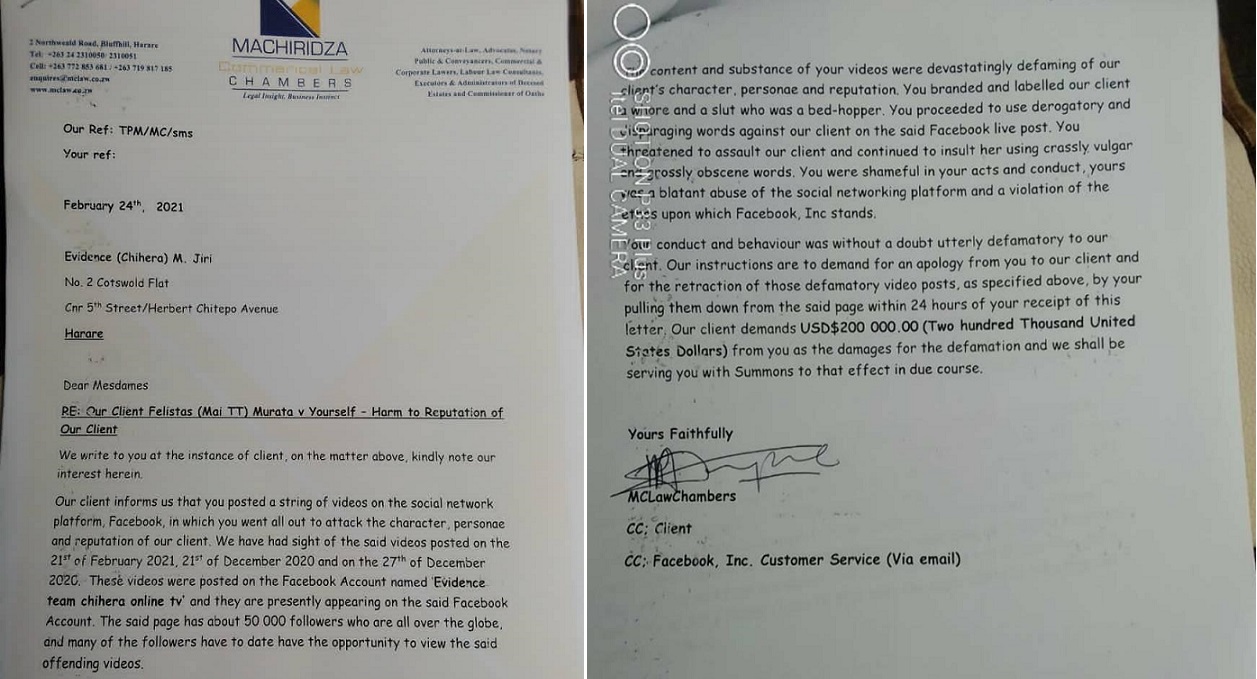
Mai Titi, real name Felistus Murata Edwards, is alleging that Chihera defamed her on social media platforms by calling her a “whore and a slut who was a bed-hopper” in a series of live videos on Facebook.

Chihera who started as a gospel singer before dumping preaching for the lures of being a thigh vendor and media personality is alleged to have used derogatory vulgar language to insult Mai Titi. The erstwhile gospel musician is further alleged to have threatened to physically harm Mai Titi.
Mai Titi has since enlisted the services of lawyers, Machiridza Commercial Law Chambers to seek redress from Chihera. The lawyers have written to Chihera demanding that she pull down all the offending videos. They have also informed her that they will soon be filing a defamation lawsuit demanding US$200,000 in defamation damages.

iHarare is publishing the letter of demand written by Mai Titi’s lawyers to Evidence “Chihera” Jiri below in its entirety.
Ironically, Mai Titi has also been on the receiving end of such a lawsuit.

Last year Mai Titi was slapped with a ZWL$500,000 defamation lawsuit by one of her former friends Memory Muyaka. Muyaka who is the owner of Khloe’s Home Decor (Private) Limited alleged that the comedian had defamed her by calling her ” a prostitute, a witch and a gossiper” on social media platforms. Muyaka, who is also known as Mai Ma Curtain, further alleged that Mai Titi falsely accused her and three others (Prophet Passion Java, Tyra ‘Madam Boss’ Chikocho and Wanisai ‘Mahwindo’ Mutandwa) of wanting to kill her.

The matter was heard before Harare High Court judge Justice Edith Mushore who after going through the records and hearing from Muyaka’s legal counsel ordered Mai Titi to pay the $500 000 damages that her former friend was demanding. Justice Mushore also slapped Mai Titi with the costs of the lawsuit and ordered that she should pay the $500 000 at the prescribed interest rate starting from the day of judgment to the date of full payment.

  • Share:

Info News

Climate Change and Global Environmental Challenges

Climate change is one of the most pressing issues facing humanity today. Rising global temperatures, severe weather events, melting glaciers, and increasing sea levels are affecting millions of people worldwide. Scientists warn that continued greenhouse gas emissions could lead to devastating environmental, economic, and social consequences if urgent action is not taken.

rnrn

One major cause of climate change is the burning of fossil fuels such as coal, oil, and natural gas. These activities release large amounts of carbon dioxide into the atmosphere, trapping heat and contributing to global warming. Deforestation, industrial pollution, and unsustainable agricultural practices also worsen environmental degradation and biodiversity loss.

rnrn

Climate change affects both developed and developing countries. In Africa, droughts and unpredictable rainfall patterns threaten food security and agriculture. Coastal communities face flooding risks due to rising sea levels, while extreme weather events such as hurricanes and wildfires continue increasing globally. These environmental challenges also place economic pressure on governments and vulnerable populations.

rnrn

Renewable energy technologies such as solar power, wind energy, and hydroelectric systems offer sustainable alternatives to fossil fuels. Many countries are investing heavily in clean energy infrastructure to reduce carbon emissions and improve energy security. Environmental experts emphasize the importance of international cooperation, conservation efforts, and public awareness campaigns in addressing climate change effectively.

rn

Global Cost of Living Crisis: How Families Around the World Are Adapting to Rising Prices

The rising cost of living continues to affect millions of families across the world as inflation, housing costs, and food prices place pressure on household budgets. From the United States and Canada to Nigeria, South Africa, Kenya, Ghana, Zimbabwe, the United Kingdom, and Australia, many people are searching for ways to manage increasing expenses while maintaining financial stability.

rnrn

One of the biggest challenges facing households is the rising cost of food and transportation. Fuel price increases have affected supply chains globally, leading to higher prices for groceries, public transport, and imported goods. Families in both developed and developing countries are adjusting spending habits by reducing unnecessary purchases, cooking meals at home, and seeking additional income opportunities online.

rnrn

Housing affordability has also become a major issue in many cities around the world. Rent prices and mortgage costs continue to rise as demand for housing outpaces supply. Young adults and middle-income families are finding it increasingly difficult to purchase homes or secure affordable rental properties. Financial experts recommend budgeting carefully, improving credit scores, and comparing loan options before making major financial commitments.

rnrn

The global job market is also evolving as more people seek remote work opportunities and digital income streams. Freelancing, online businesses, content creation, and remote technology jobs are becoming popular alternatives for individuals seeking financial flexibility. In countries across Africa, mobile technology and digital payments are helping entrepreneurs build businesses and reach customers internationally.

rnrn

Financial literacy has become more important than ever during the economic slowdown. Experts encourage individuals to create emergency savings funds, reduce high-interest debt, and avoid unnecessary financial risks. Many banks and financial institutions are also offering budgeting tools and savings programs designed to help consumers manage expenses more effectively.

rnrn

Technology is playing a major role in helping people adapt to economic pressures. Price comparison apps, digital banking services, and online marketplaces are helping consumers save money and access more affordable products. Social media platforms are also being used to share financial advice, business ideas, and money-saving strategies across different countries and communities.

rnrn

Despite current economic challenges, analysts believe innovation and entrepreneurship will continue driving growth opportunities in emerging markets. African economies in particular are experiencing increased investment in technology, renewable energy, and digital commerce. Young entrepreneurs across Nigeria, Kenya, Ghana, Zimbabwe, and South Africa are building businesses that reach global audiences through online platforms.

rnrn

Economists predict that inflation and living costs may remain a major topic worldwide throughout the coming years. However, experts believe individuals who focus on financial planning, digital skills, and long-term investment strategies will be better positioned to navigate future economic uncertainty successfully.

rn