Veteran television actress, Rhoda Mtembe, popularly known as Mai Sorobhi in the yesteryear drama “Paraffin” is reported to be languishing in poverty as economic woes take their toll. The sad state of the once plump 76-year-old is in no way consistent with someone who once had a nation glued to the television screen.
Having suffered a stroke early this year, Mtembe is now handicapped and can hardly walk. Soon after the stroke, Mtembe made an appeal to get physiotherapy assistance so that she could regain her movement abilities and maybe her dream to revive her acting career.
Mai Sorobhi was wife to the late Phillip Mushangwe in the drama series, Paraffin, where Mushangwe played the role of Paraffin.
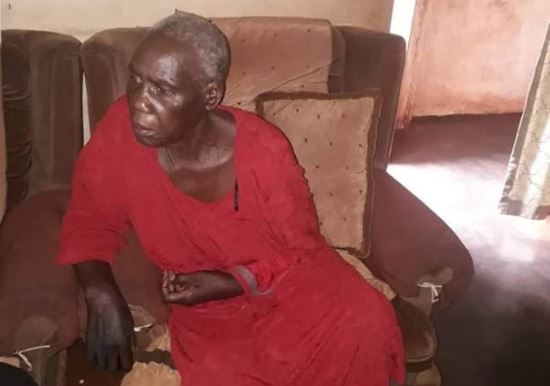
Mtembe quit acting some years back citing that it did not pay well.
In the years following independence, Zimbabwe’s film industry was thriving. Now, the recent economic crisis is taking a toll.
For those who would want to assist Charity Mtembe Sorobhi please call 0771713693. Address 1437/1 Kuwadzana extension.
related stories
Mai Sorobhi misses Paraffin
When Paraffin and his wife Mai Sorobhi visit a dentist for treatment of the latter’s toothache, there is real drama. Mai Sorobhi is in pain and clinic staff appear too slow for Paraffin who feels for his wife. The situation gets worse when a worker at the clinic gives Amai Sorobhi condoms and she accepts them. Paraffin makes a scene at the clinic, scolding the attendants and vehemently protesting against their actions.
The way he does it triggers both sympathy and excitement.
That was an episode from yesteryear television series “Paraffin” featuring Paraffin whose real name was Philip Mushangwe and Rhoda Mtembi as Amai Sorobhi.
The episode was titled “Zino” and 20 years down the line Mtembi still cherishes her role as wife to mischievous Paraffin.
The zimbolivenews Entertainment caught up with her last week at her Kuwadzwana Extension house where she spoke on different issues about her life and career. However the feels cheated, neglected and duped by upcoming producers.
Nothing much has changed about her. She is still energetic, outspoken and comical.
Mai Sorobhi who was a no nonsense wife was the only one who could make sober her notorious husband Paraffin in the drama series.
She narrated how she got to meet her late screen partner, Paraffin.
“I was a health promoter working at a clinic in Glen View and acting in dramas that focused on child abuse, HIV and Aids. One day Aaron Chiundura Moyo (author) came to watch our drama in which I acted as a male figure.
“He was impressed by my performance and he took me to ZBCTV for auditions,” she recalled.
She added that although she was first given a male actor to work with, they did not click until Paraffin came into the picture.
“At first I was given a role as wife to the late Mutirowafanza but our combination was not perfect but when I acted with Baba Sorobhi it became perfect, and that is how our relationship began.”
Regardless of the time that has elapsed, she vividly recalls some of her best episodes that include “Zino” and “Nduna”.
“I classify ‘Zino’ as the best of all our episodes, I remember very well how we were personally impressed by that act. ‘Nduna’ was also a good episode.”
In “Nduna” she had two sons Nduna and Cambion who were very mischievous and arrogant and Paraffin advices Mai Sorobhi to take the two sons for medical attention for them to reason normally.
Mai Sorobhi who acted her role with perfection said their close professional relationship with Paraffin never negatively affected their marriages.
“I never encountered any challenges with his real wife. She loved me and actually acted with her in the episode when we did modelling. She was that fat woman if you recall the episode,” she said laughing.
“My late husband was very supportive and was never jealousy of my screen partner and he trusted me a lot. We wanted him to be part of the cast but he refused because he was not talented in acting.”
She clearly remembers that celebrity recognition she used to have those days from all over.
“It was a great experience those days, wherever I went people would call me ‘Mai Sorobhi’ and I was proud of that.
“Up to now when l come across people in the streets they still greet me and ask, ‘Mai Sorobhi did your teeth heal?’
She said the other time she had to use her tricks to withdraw money from the bank. “I remember this other day when I carried a newspaper that had my face to a bank and l realised that I had forgotten my national identity card at home.
“I requested to see the manager and I told him that I am Mai Sorobhi. I showed him the paper and he just laughed and allowed me to withdraw the amount I needed.
“Usually I don’t wait in queues to get something, people still give me respect,” she added.
The veteran actress appeared in dramas such as “Asi Chii Nhai”, “Mwana Anokosha”, “Paraffin 1 to 3” but could not complete shooting part 4 “Nhamo” after the death of the main actor Paraffin. She said after Paraffin’s death it became difficult for her to land other opportunities in other plays. She tried to return in 2009 with a drama called “Simbimbino” that was a flop.
Now at the age of 71, Mai Sorobhi still wants to return to the screen although she feels reluctant now.
“I still have deep passion to be part of a cast but what has been happening is discouraging me.
“I’m always given empty promises. This year in January I was approached by a certain guy who wanted me to be part of his drama.
“I agreed, was given script and I acted my part and he just said we will give you a call soon but he never returned. I only realised it later that I was used as I heard that the play was being sold in South Africa.
“But now I’m clever, people think they can use me but they will not be successful. They have to understand that acting is a business, I no longer agree to act when there is no proper agreement,” she said angrily.
Mai Sorobhi’s voice cracked as she shared how much she misses Paraffin and wished he was still alive.
“If he had lived longer I believe we could have taken our talents to higher levels.
“We understood each other well and would correct each other when one missed a line in a special way that nobody could notice.” Mai Sorobhi said discipline in her career has preserved her life up to date.
“It pains me because most of yesteryear actors are dead. I think the main reason why they died early is because they were lured by wrong things. I never stretched beyond professional relationship with my colleagues.
Like any other actor in Zimbabwe, Mai Sorobhi has a heart-breaking story to tell
“There are no people who really support dramas these days. Back then it was lucrative and I bought this (Kuwadzana Extension) house with money from acting.” She still believes yesteryear dramas were the best as compared to current productions.
“Madrama amazuva ano anyanya chinoz-noz, heeh wasup nigga what, what and it’s difficult for older people to understand them. In our productions we used Shona that most people could understand clearly.”
Mai Sorobhi is now employed by Harare City Council as a health promoter and she goes around teaching people about hygiene.
Mai Sorobhi’s real husband Vaxison Mtembe passed away in 2001 and the couple were blessed with seven children and fifteen grandchildren.
Info News
SEO Meta Title Car Insurance Quotes: Compare Coverage and Save
Car insurance quotes can look simple at first glance, but two policies with the same monthly price can offer very different protection. One may include stronger liability limits, rental reimbursement, roadside assistance, accident forgiveness, or better uninsured motorist coverage. Another may look cheaper because it has a high deductible, low limits, or fewer coverage options. To avoid overpaying or buying weak coverage, compare quotes line by line.
Start with liability coverage. Liability insurance helps pay for injuries or property damage you cause to others in a covered accident. Most states require a minimum amount, but minimum coverage can be too low after a serious crash. Medical bills, vehicle repairs, legal defense, and judgments can rise quickly. When comparing quotes, look at bodily injury liability per person, bodily injury liability per accident, and property damage liability.
Next, review collision and comprehensive coverage. Collision coverage may help repair or replace your vehicle after a covered crash, regardless of who was at fault. Comprehensive coverage may help with theft, vandalism, hail, fire, falling objects, and certain weather-related damage. If you have a loan or lease, your lender may require both. If your vehicle is older and paid off, you can compare the cost of keeping physical damage coverage against the value of the car and your ability to replace it.
Uninsured and underinsured motorist coverage is often overlooked. It may help if another driver causes an accident and has no insurance or not enough insurance. In some states, this coverage can also apply to hit-and-run situations. Because not every driver carries strong limits, this coverage can be important even for careful drivers.
Medical payments coverage or personal injury protection may help with medical costs after an accident. The names and rules vary by state. Some states require personal injury protection, while others make it optional. If you already have health insurance, you may still want to understand how deductibles, passengers, lost wages, and claim handling work under your auto policy.
Deductibles are another major price factor. A higher deductible can lower the premium, but it also means you pay more out of pocket when filing a claim. Choose a deductible you could realistically pay after an accident. Saving a few dollars per month may not be worth it if the deductible would create financial stress.
Discounts can make a big difference, but they are not the same at every company. Ask about safe driver discounts, multi-policy discounts, multi-car discounts, good student discounts, defensive driving courses, low mileage programs, telematics programs, anti-theft devices, paperless billing, and paid-in-full discounts. Telematics can reward safe driving, but it may also use driving data such as speed, braking, mileage, and time of day. Read the details before enrolling.
When shopping, collect at least three quotes using the same coverage limits and deductibles. If one quote is much cheaper, ask why. It may exclude something important or use a different coverage level. Also check the insurer's claims reputation, customer service, financial strength, mobile app experience, and local agent availability.
Be careful with the phrase full coverage. It is not a standard legal term. People often use it to mean liability plus comprehensive and collision, but it may not include rental car coverage, gap insurance, roadside assistance, original equipment manufacturer parts, or high liability limits. Instead of asking for full coverage, specify the coverage types and limits you want.
Your personal situation also affects pricing. Insurers may consider your driving record, location, vehicle type, mileage, coverage history, age, claims history, and sometimes credit-based insurance scores where allowed. Because pricing models differ, the cheapest insurer for one driver may not be cheapest for another.
Review your policy after major life changes. Moving, buying a car, paying off a loan, adding a teen driver, getting married, changing jobs, or driving fewer miles can affect your coverage and premium. You should also compare rates before renewal because loyalty does not always guarantee the best price.
The goal is not simply to find the cheapest car insurance quote. The goal is to find a policy that balances price, protection, claim service, and peace of mind. A strong comparison process can help you avoid coverage gaps while still keeping the premium under control.
Renewable Energy Investments Continue Growing Worldwide
Renewable energy is becoming one of the most important industries in the global economy as countries seek cleaner and more sustainable alternatives to fossil fuels. Solar power, wind energy, hydroelectric systems, and battery storage technologies are helping reduce environmental pollution while supporting economic development and energy security.
rnrn
Governments and private companies are investing billions into renewable energy infrastructure projects designed to reduce carbon emissions and expand electricity access. Solar energy has become especially popular in regions with abundant sunlight, including parts of Africa, Australia, and the Middle East.
rnrn
Electric vehicles are also contributing to renewable energy growth by reducing reliance on gasoline and diesel-powered transportation. Advances in battery technology and charging infrastructure are making electric vehicles more practical and affordable for consumers worldwide.
rnrn
Renewable energy industries are creating thousands of jobs in engineering, manufacturing, construction, and technology sectors. Experts believe clean energy investments will continue driving innovation and long-term economic growth in both developed and emerging markets.
rn


