Tuesday, November 17

Zimbabwe Suspends Mobile Money Platforms Ecocash & trading On Stock Exchange

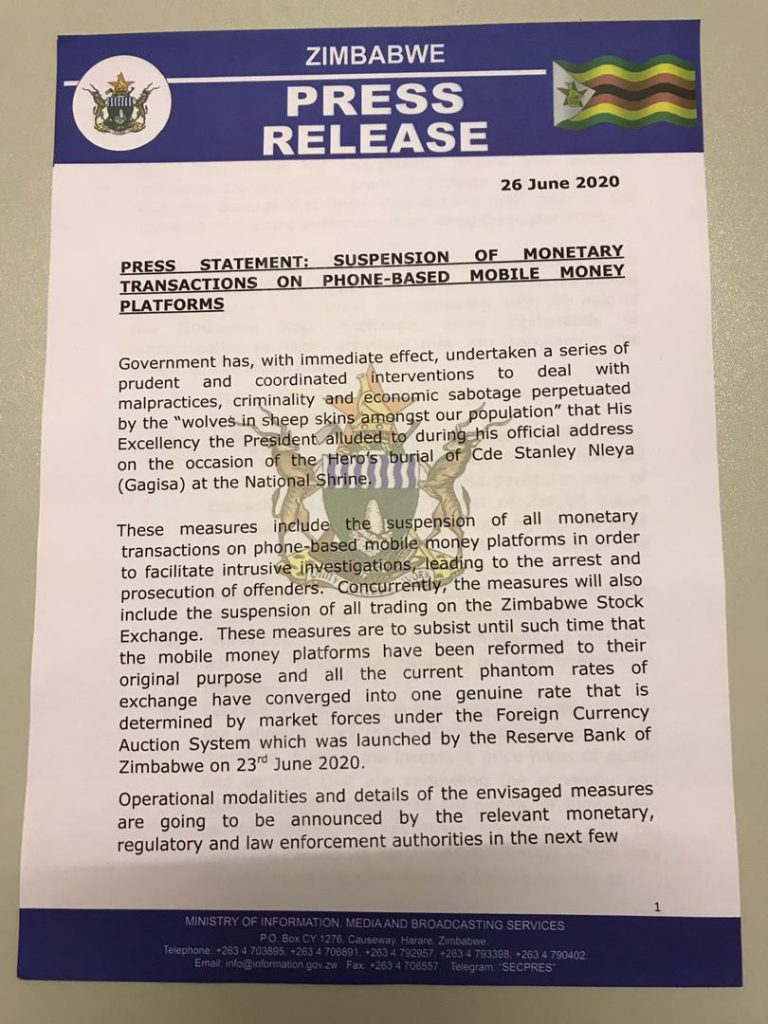
The Government has suspended mobile money platforms EcoCash, One Money and Telecash among others as well as trading on the Zimbabwe Stock Exchange until further notice.Government said the move was to curtail what it claimed was economic sabotage perpetrated by the “wolves in sheep skins amongst our populations”.


Government has accused the mobile platforms of facilitating the skyrocketing of rates in the markets. In a statement seen by Nehanda Radio, government through the Information Ministry confirmed the development adding that the measures would subsist until the the mobile platforms are reformed.

“Government has with immediate effect undertaken a series of prudent and coordinated interventions to deal with malpractices, criminality and economic sabotage perpetuated by the wolves in sheep skins amongst our population that his Excellency the President alluded to during his official address on the occasion of heroes burial of Cde Stanely Nleya (Gagisa) at the National Shrine.

“The measures include the suspension of all monetary transactions on phone-based mobile money platforms in order to facilitate intrusive investigations leading to the arrest and prosecution of offenders. Concurrently the measures will also include the suspension of all trading on the Zimbabwe Stock Exchange.
“These measures are to subsist until such time that the mobile money platforms have been reformed to their original purpose and all the phantom rate of exchange have converged into one genuine rate that is determined by the market forces under the Foreign Currency Auction System which was launched by the Reserve Bank of Zimbabwe of the 23rd June 2020,” read the statement.

Four days ago, the RBZ replaced the interbank market with weekly foreign exchange auctions to determine the Zimbabwe dollar exchange rate.

Government added that the operational modalities and details of the envisaged measures are going to be announced by the relevant monetary, regulatory and law enforcement authorities in the next few days.

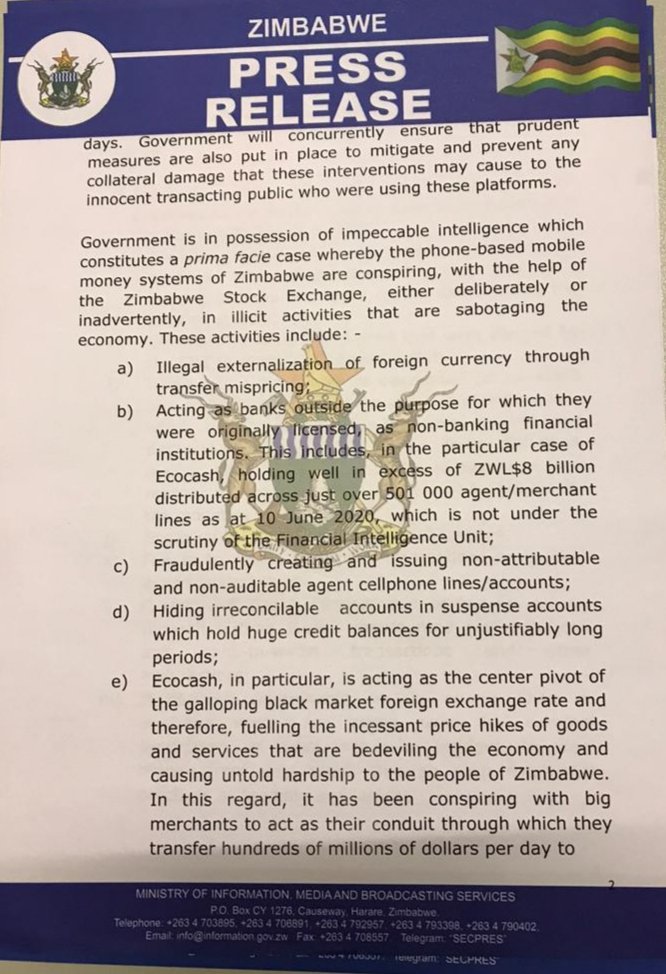
“Government will concurrently ensure that prudent measures are also put in place to mitigate and prevent any collateral damage that these interventions may cause to the innocent transacting public who were using these platforms.

“Government is in possession of impeccable intelligence which constitutes a prima facie case whereby the phone-based mobile money systems of Zimbabwe are conspiring, with the help of the Zimbabwe Stock Exchange, either deliberately or inadvertently, in illicit activities that are sabotaging the economy.
These activities include: –

a) Illegal externalization of foreign currency through transfer mispricing;

b) Acting as banks outside the purpose for which they were originally licensed, as non-banking financial institutions. This includes, in the particular case of Ecocash, holding well in excess of ZWL$8 billion distributed across just over 501 000 agent/merchant lines as at 10 June 2020, which is not under the scrutiny of the Financial Intelligence Unit;

c) Fraudulently creating and issuing non-attributable and non-auditable agent cellphone lines/accounts;

d) Hiding irreconcilable accounts in suspense accounts which hold huge credit balances for unjustifiably long periods;

e) Ecocash, in particular, is acting as the centre pivot of the galloping black market foreign exchange rate and therefore, fuelling the incessant price hikes of goods and services that are bedevilling the economy and causing untold hardship to the people of Zimbabwe.

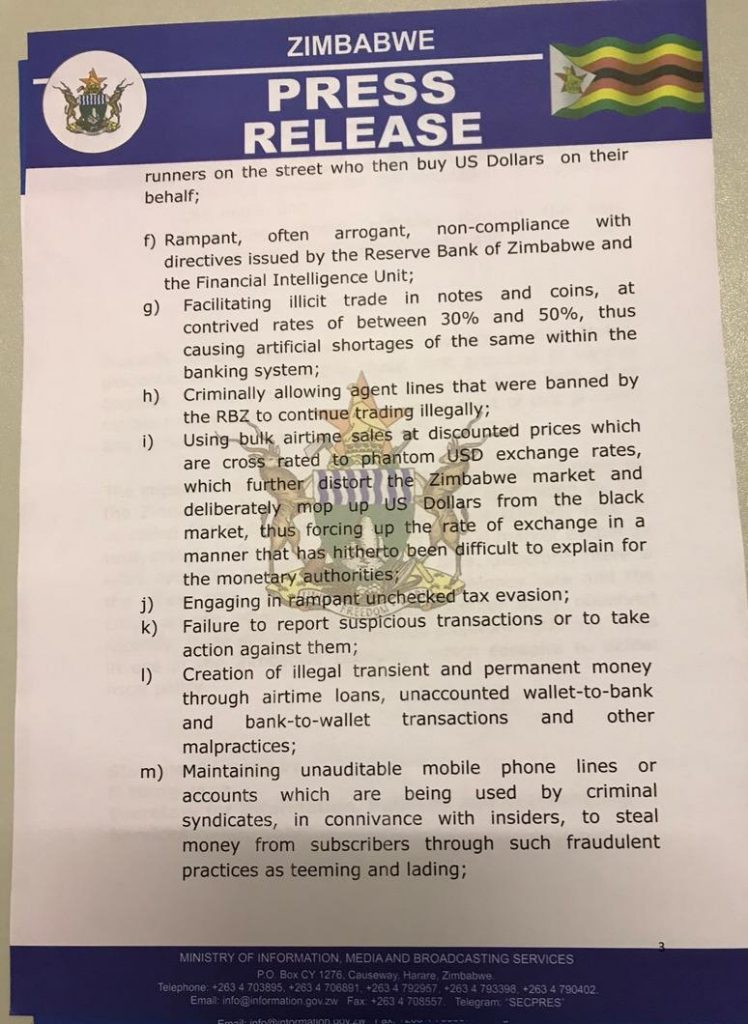
In this regard, it has been conspiring with big merchants to act as their conduit through which they transfer hundreds of millions of dollars per day to runners on the street who then buy US Dollars on their behalf;

f) Rampant, often arrogant, non-compliance with directives issued by the Reserve Bank of Zimbabwe and the Financial Intelligence Unit;

g) Facilitating illicit trade in notes and coins, at contrived rates of between 30% and 50%, thus causing artificial shortages of the same within the banking system;

h) Criminally allowing agent lines that were banned by the RBZ to continue trading illegally;

i) Using bulk airtime sales at discounted prices which are cross rated to phantom USD exchange rates, which further distort the Zimbabwe market and deliberately mop up US Dollars from the black market, thus forcing up the rate of exchange in a manner that has hitherto been difficult to explain for
the monetary authorities;

j) Engaging in rampant unchecked tax evasion;

k) Failure to report suspicious transactions or to take action against them;

l) Creation of illegal transient and permanent money through airtime loans, unaccounted wallet-to-bank and bank-to-wallet transactions and other malpractices;

m) Maintaining auditable mobile phone lines or accounts which are being used by criminal syndicates, in connivance with insiders, to steal money from subscribers through such fraudulent practices as teeming and lading;

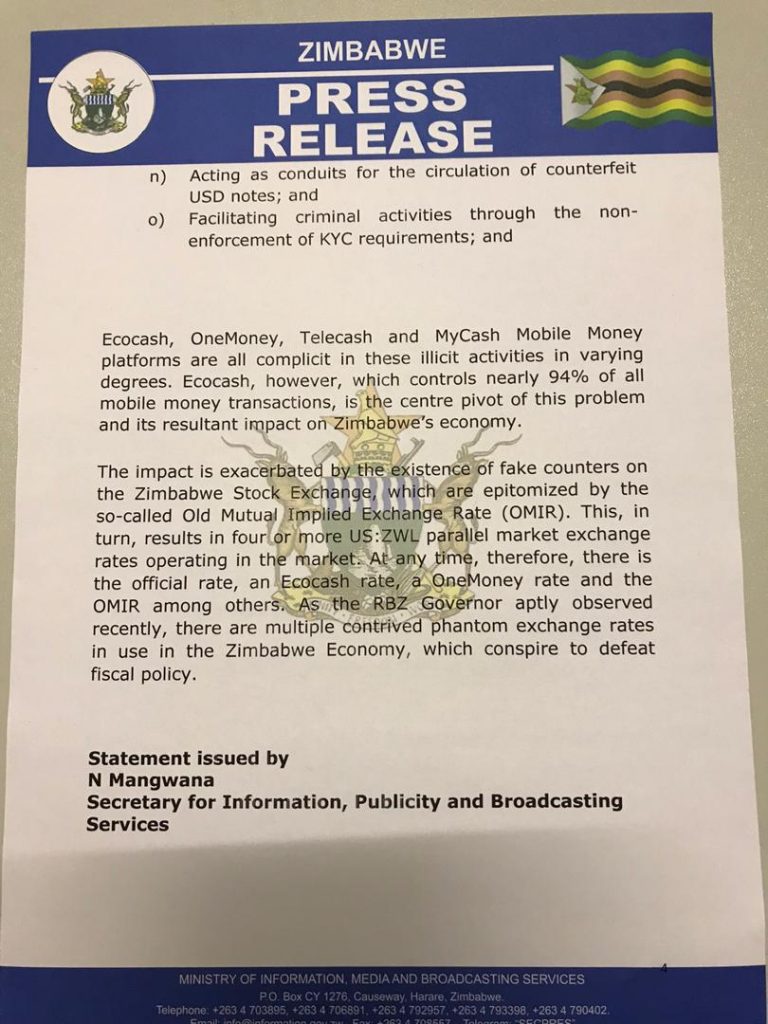
n) Acting as conduits for the circulation of counterfeit USD notes; and

o) Facilitating criminal activities through the non-enforcement of KYC requirements; and

“Ecocash, OneMoney, Telecash and MyCash Mobile Money platforms are all complicit in these illicit activities in varying degrees. Ecocash, however, which controls nearly 94% of all mobile money transactions, is the centre pivot of this problem and its resultant impact on Zimbabwe’s economy.

“The impact is exacerbated by the existence of fake counters on the Zimbabwe Stock Exchange, which is epitomized by the so-called Old Mutual Implied Exchange Rate (OMIR). This, in turn, results in four or more US: ZWL parallel market exchange rates operating in the market.

“At any time, therefore, there is the official rate, an Ecocash rate, an OneMoney rate, and the OMIR among others. As the RBZ Governor aptly observed recently, there are multiple contrived phantom exchange rates in use in the Zimbabwe Economy, which conspire to defeat fiscal policy, ” further read the statement.

  • Share:

Info News

SEO Meta Title Credit Repair vs Credit Counseling: Compare Your Options

When credit problems become stressful, two options often appear in search results: credit repair and credit counseling. They sound similar, but they are not the same service. Credit repair focuses on disputing inaccurate, incomplete, or unverifiable information on credit reports. Credit counseling focuses on budgeting, debt repayment, and financial education. Knowing the difference can help you avoid scams and choose the right help.

Credit repair companies often advertise help with removing negative items from credit reports. Legitimate credit repair is based on your legal right to dispute inaccurate information. If a late payment, collection, account balance, personal detail, or account status is wrong, you can dispute it with the credit bureaus and the company that furnished the information.

However, accurate negative information usually cannot be removed simply because it hurts your score. Late payments, collections, bankruptcies, and charge-offs may remain on credit reports for legally allowed periods if they are accurate. Be cautious with any company that promises a specific score increase, guaranteed removals, or a new credit identity.

Credit counseling is different. A nonprofit credit counseling agency can review income, expenses, debts, and goals. Counselors may help build a budget, explain credit reports, suggest repayment strategies, and discuss whether a debt management plan makes sense. A debt management plan may consolidate payments through the counseling agency and sometimes reduce interest rates or fees with participating creditors.

Credit counseling can be useful when the main problem is debt affordability. If you are making minimum payments, falling behind, or using one card to pay another, a counselor can help create a structured plan. Credit repair alone will not solve unaffordable debt.

Credit repair can be useful when the main problem is inaccurate reporting. For example, an account that does not belong to you, a debt listed twice, an incorrect late payment, a paid account still shown as unpaid, or outdated information may be disputable. You can file disputes yourself for free, but some people hire help because they do not want to manage the paperwork.

Before paying for credit repair, understand your rights. In the United States, credit repair companies must follow federal rules, including restrictions on misleading claims and upfront fees. You should receive a written contract, cancellation rights, and clear information about what the company will do. If a company pressures you, asks you to lie, tells you to dispute everything, or suggests using a different Social Security number, walk away.

A strong credit rebuilding plan often includes both cleanup and behavior changes. Start by pulling credit reports from the major bureaus. Review personal information, open accounts, closed accounts, collections, public records, inquiries, balances, and payment history. Highlight anything inaccurate and gather supporting documents.

Next, pay every current bill on time. Payment history is a major scoring factor. Set up reminders or autopay for minimum payments. Then focus on credit utilization, which is the percentage of available revolving credit being used. Lower balances can help improve scores over time.

Avoid opening too many new accounts at once. New inquiries and new accounts can lower scores temporarily. Instead, build a steady pattern: pay on time, reduce balances, keep older accounts in good standing, and monitor reports for errors.

If you have no active credit, a secured credit card or credit-builder loan may help, but fees and terms matter. Choose products from reputable banks or credit unions and avoid high-fee cards that drain your budget.

The right choice depends on the root problem. Choose credit repair if the issue is inaccurate reporting. Choose credit counseling if the issue is debt management, budgeting, or missed payments. Use both if you have errors and unaffordable debt. Most importantly, avoid anyone promising instant results. Real credit improvement takes accurate reporting, consistent payments, lower debt, and time.

Average Mesothelioma Settlement Amounts in 2026 Explained

Mesothelioma lawsuits remain some of the highest-value legal cases in the United States. Settlement amounts can reach hundreds of thousands or even millions of dollars depending on the exposure history, medical costs, and long-term impact on the victim’s life.

rnrn

But here’s what many families quickly discover.

rnrn

No two mesothelioma settlements are exactly the same.

rnrn

Some victims receive compensation relatively quickly. Others face long legal battles involving multiple companies, insurance providers, and asbestos trust funds.

rnrn

If you’re trying to understand average mesothelioma settlement amounts in 2026, you need realistic information instead of exaggerated promises.

rnrn

Why Mesothelioma Cases Lead to Large Settlements

rnrn

Mesothelioma is strongly linked to asbestos exposure.

rnrn

For decades, many companies knew asbestos exposure carried serious health risks but continued using asbestos-containing materials anyway.

rnrn

That history matters in court.

rnrn

Victims often develop:

rnrn
    rn
  • Severe respiratory illness
  • rn
  • Expensive medical complications
  • rn
  • Long-term disability
  • rn
  • Loss of income
  • rn
  • Significant pain and suffering
  • rn
rnrn

Because the disease is aggressive and treatment costs are high, settlement amounts can become substantial.

rnrn

Average Mesothelioma Settlement Ranges in 2026

rnrn

Settlement values vary widely.

rnrn

Several legal firms report many cases settling between:

rnrn
    rn
  • $1 million to $2 million
  • rn
  • Higher amounts for severe exposure cases
  • rn
  • Lower settlements for limited liability situations
  • rn
rnrn

Some trial verdicts can exceed those numbers significantly.

rnrn

But trials also carry more uncertainty.

rnrn

That’s why many cases resolve through negotiated settlements.

rnrn

What Factors Affect Mesothelioma Settlement Amounts?

rnrn

This is where cases become highly individualized.

rnrn

Several key factors influence compensation.

rnrn

Extent of Asbestos Exposure

rnrn

Lawyers investigate where and how exposure occurred.

rnrn

This may involve:

rnrn
    rn
  • Construction sites
  • rn
  • Shipyards
  • rn
  • Military service
  • rn
  • Manufacturing plants
  • rn
  • Industrial equipment
  • rn
  • Automotive work
  • rn
rnrn

Long-term exposure histories often strengthen claims.

rnrn

Medical Expenses and Future Treatment Costs

rnrn

Mesothelioma treatment is expensive.

rnrn

Victims may require:

rnrn
    rn
  • Chemotherapy
  • rn
  • Surgery
  • rn
  • Radiation therapy
  • rn
  • Travel for specialists
  • rn
  • Long-term care
  • rn
  • Experimental treatments
  • rn
rnrn

Future medical costs are often included when calculating damages.

rnrn

Lost Income and Financial Impact

rnrn

Many victims can no longer work.

rnrn

Settlement negotiations may include:

rnrn
    rn
  • Past lost wages
  • rn
  • Future earning capacity
  • rn
  • Retirement losses
  • rn
  • Household financial impact
  • rn
rnrn

For families already under stress, these losses become devastating.

rnrn

Pain and Suffering Damages

rnrn

Mesothelioma cases often involve significant physical and emotional suffering.

rnrn

Compensation may account for:

rnrn
    rn
  • Chronic pain
  • rn
  • Reduced quality of life
  • rn
  • Emotional distress
  • rn
  • Family hardship
  • rn
rnrn

These damages can heavily influence final settlement amounts.

rnrn

Mesothelioma Trust Funds Explained

rnrn

Many asbestos manufacturers filed for bankruptcy years ago.

rnrn

As part of bankruptcy proceedings, trust funds were created to compensate future victims.

rnrn

Today, billions of dollars remain available through asbestos trust funds.

rnrn

Victims may qualify for compensation even if the responsible company no longer operates.

rnrn

Settlement vs Trial: Which Is Better?

rnrn

This depends on the situation.

rnrn

Benefits of Settlements

rnrn

Settlements may provide:

rnrn
    rn
  • Faster compensation
  • rn
  • Less stress
  • rn
  • Lower legal risk
  • rn
  • More privacy
  • rn
rnrn

Many families prefer settlements because they avoid lengthy court battles.

rnrn

Benefits of Going to Trial

rnrn

Some trial verdicts produce larger awards.

rnrn

However, trials also involve:

rnrn
    rn
  • Greater uncertainty
  • rn
  • Longer timelines
  • rn
  • Appeals
  • rn
  • Increased legal complexity
  • rn
rnrn

Experienced mesothelioma lawyers help clients evaluate both options carefully.

rnrn

How Long Mesothelioma Settlements Take

rnrn

Some claims resolve within several months.

rnrn

Complex cases involving multiple defendants may take much longer.

rnrn

Factors affecting timelines include:

rnrn
    rn
  • Exposure history
  • rn
  • Medical documentation
  • rn
  • Court schedules
  • rn
  • Number of companies involved
  • rn
  • Trust fund processing times
  • rn
rnrn

Victims with severe illness may sometimes receive expedited case handling.

rnrn

Why Choosing the Right Mesothelioma Lawyer Matters

rnrn

Mesothelioma litigation is highly specialized.

rnrn

Experienced asbestos attorneys often have:

rnrn
    rn
  • Access to exposure databases
  • rn
  • Historical company records
  • rn
  • Medical experts
  • rn
  • Industrial safety specialists
  • rn
  • Knowledge of asbestos trust funds
  • rn
rnrn

That experience can strongly influence settlement outcomes.

rnrn

Common Mistakes Families Make

rnrn

Unfortunately, some families wait too long to seek legal guidance.

rnrn

That can create problems because statutes of limitation apply.

rnrn

Other mistakes include:

rnrn
    rn
  • Accepting low settlement offers too early
  • rn
  • Failing to document exposure history
  • rn
  • Working with inexperienced attorneys
  • rn
  • Missing trust fund opportunities
  • rn
rnrn

The details matter more than most people realize.

rnrn

Final Takeaway

rnrn

Average mesothelioma settlement amounts in 2026 can vary dramatically based on exposure history, medical costs, and legal strategy.

rnrn

Some victims recover substantial compensation that helps cover treatment, lost income, and family support.

rnrn

But strong outcomes usually require careful documentation, experienced legal representation, and quick action before important deadlines pass.

rnrn

Families facing mesothelioma already have enough stress.

rnrn

The right legal guidance can make the financial side far more manageable.

rnrn

FAQ

rnrn

What is the average mesothelioma settlement amount?

rnrn

Many settlements fall between $1 million and $2 million, though every case is different.

rnrn

Are mesothelioma settlements taxable?

rnrn

Some portions may not be taxable, but financial and legal professionals should review individual cases.

rnrn

How long does a mesothelioma lawsuit take?

rnrn

Some cases settle within months, while others take longer depending on complexity.

rnrn

Can family members file claims after a loved one dies?

rnrn

Yes. Wrongful death claims may still allow families to seek compensation.

rnrn

What industries had the highest asbestos exposure risks?

rnrn

Construction, shipbuilding, manufacturing, automotive repair, and military service were among the highest-risk industries.

rn