Thursday, November 19

Vice President Mohadi Resigns Over Sex Scandal

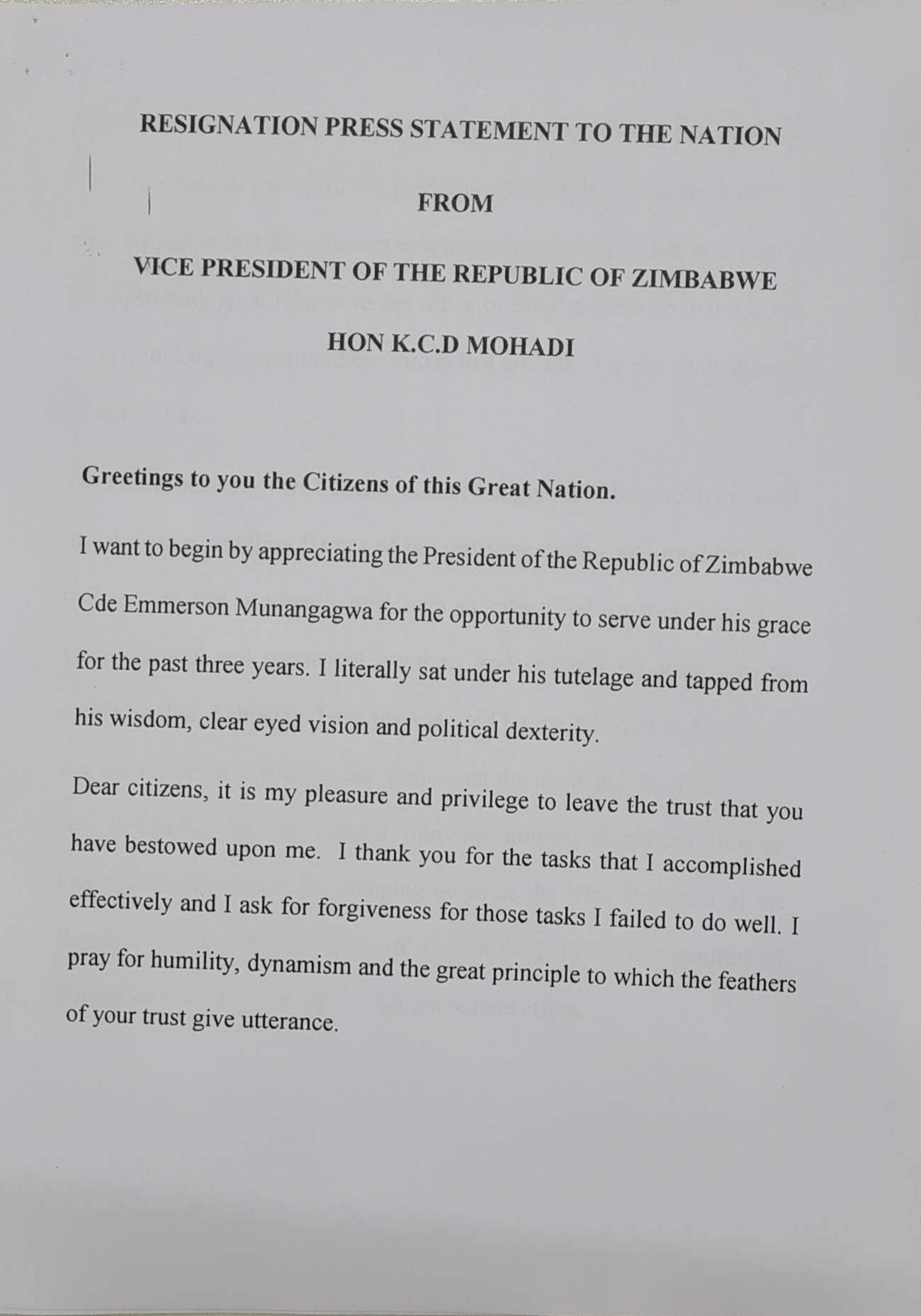
Vice President Kembo Mohadi has tendered his resignation to President with immediate effect. The News that Mohadi has resigned was shared by the Ministry of Information which shared Mohadi’s resignation letter that stated that he is resigning as a way to demonstrate great respect to the office of the President so that it is not compromised or caricatured by actions that are linked to his challenges as an individual.

In his resignation letter Mohadi said:

Greetings to you the Citizens of this Great Nation.

I want to begin by appreciating the President of the Republic of Zimbabwe Cde Emmerson Munangagwa for the opportunity to serve under his grace for the past three years. I literally sat under his tutelage and tapped from his wisdom, clear eyed vision and political dexterity.
Dear citizens, it is my pleasure and privilege to leave the trust that you have bestowed upon me. I thank you for the tasks that I accomplished effectively and I ask for forgiveness for those tasks I failed to do well. I pray for humility, dynamism and the great principle to which the feathers of your trust give utterance.
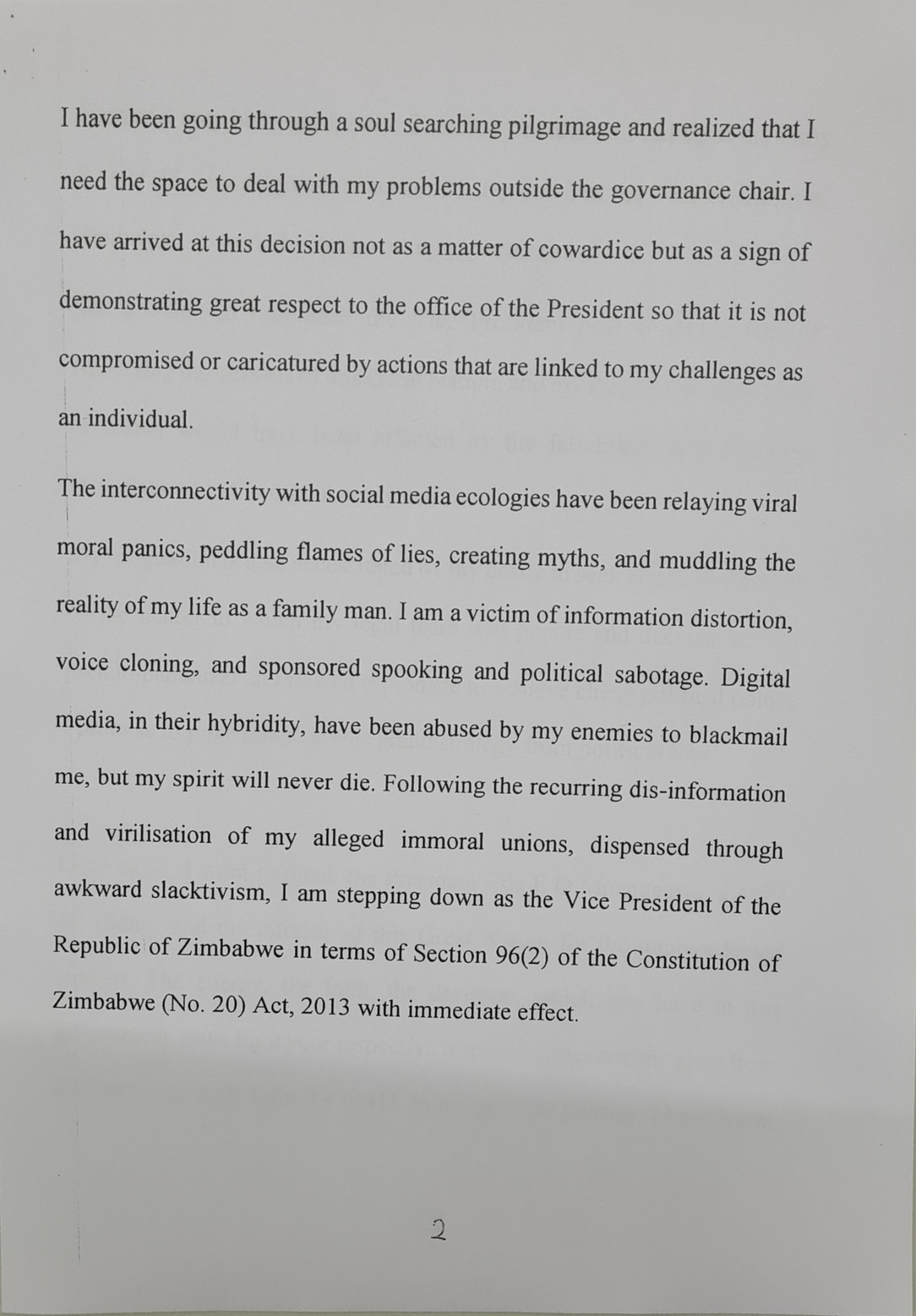
I have been going through a soul-searching pilgrimage and realized that I need the space to deal with my problems outside the governance chair. I have arrived at this decision not as a matter of cowardice but as a sign of demonstrating great respect to the office of the President so that it is not compromised or caricatured by actions that are linked to my challenges as an individual.

The interconnectivity with social media ecologies have been relaying viral moral panics, peddling flames of lies, creating myths, and muddling the reality of my life as a family man. I am a victim of information distortion, voice cloning, and sponsored spooking and political sabotage. Digital media, in their hybridity, have been abused by my enemies to blackmail me, but my spirit will never die. Following the recurring dis-information and virilization of my alleged immoral unions, dispensed through awkward slacktivism, I am stepping down as the Vice President of the Republic of Zimbabwe in terms of Section 96(2) of the Constitution of Zimbabwe (No. 20) Act, 2013 with immediate effect.

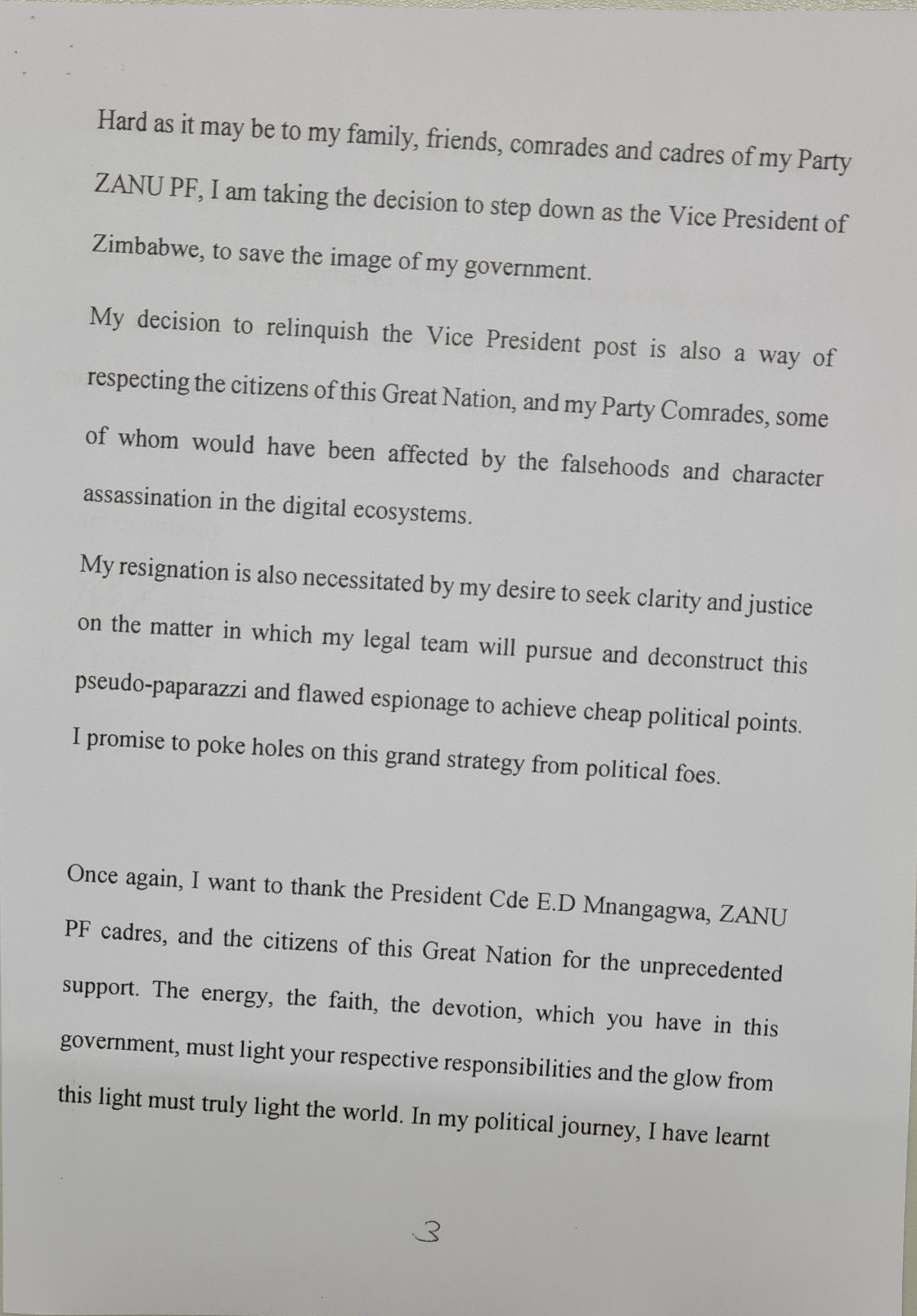
Ili Hard as it may be to my family, friends, comrades and cadres of my Party ZANU PF, I am taking the decision to step down as the Vice President of Zimbabwe, to save the image of my government.

My decision to relinquish the Vice President post is also a way of respecting the citizens of this Great Nation, and my Party Comrades, some of whom would have been affected by the falsehoods and character assassination in the digital ecosystems.

My resignation is also necessitated by my desire to seek clarity and justice on the matter in which my legal team will pursue and deconstruct this pseudo-papar and flawed espionage to achieve cheap political points. I promise to poke holes on this grand strategy from political foes.

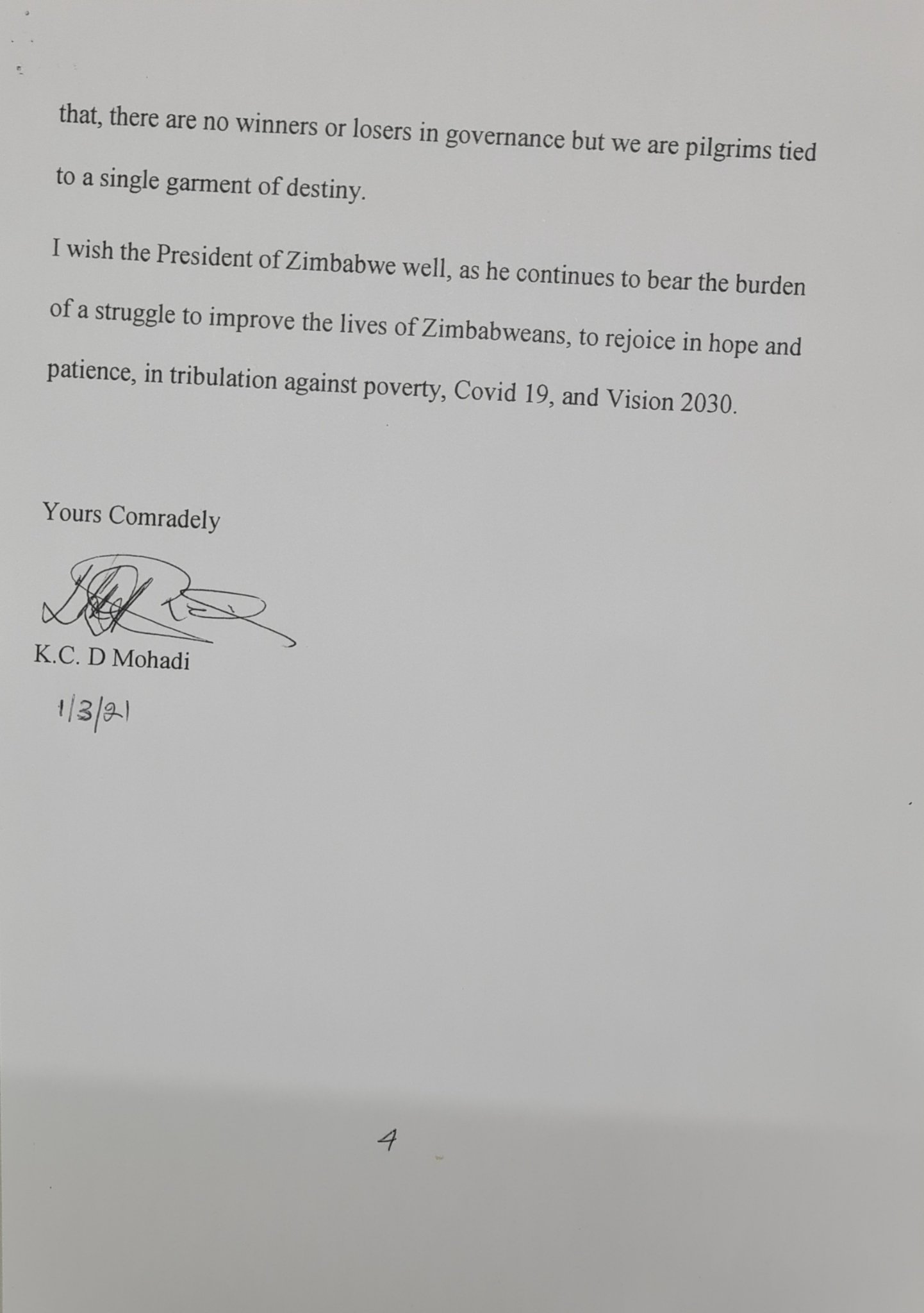
Once again, I want to thank the President Cde E.D Mnangagwa, ZANU PF cadres, and the citizens of this Great Nation for the unprecedented support. The energy, the faith, the devotion, which you have in this government, must light your respective responsibilities and the glow from this light must truly light the world. In my political journey, I have learntthat, there are no winners or losers in governance but we are pilgrims tied to a single garment of destiny.
I wish the President of Zimbabwe well, as he continues to bear the burden of a struggle to improve the lives of Zimbabweans, to rejoice in hope and patience, in tribulation against poverty, Covid 19, and Vision 2030.
Yours Comradely

K.C. D Mohadi

  • Share:

Info News

Best Cybersecurity Services for Financial Institutions

Financial institutions face nonstop cyber threats in 2026.

rnrn

Hackers target banks, lenders, investment firms, and payment platforms because financial data remains incredibly valuable.

rnrn

One successful breach can destroy customer trust overnight.

rnrn

That’s why demand for the best cybersecurity services for financial institutions keeps growing rapidly.

rnrn

Why Financial Firms Face Elevated Risk

rnrn

Cybercriminals aggressively pursue:

rnrn
    rn
  • Customer account information
  • rn
  • Wire transfer access
  • rn
  • Banking credentials
  • rn
  • Loan application data
  • rn
  • Investment accounts
  • rn
rnrn

AI-powered attacks are making threats even more sophisticated.

rnrn

Critical Security Services Financial Firms Need

rnrn

Strong cybersecurity strategies often include:

rnrn
    rn
  • Endpoint protection
  • rn
  • SIEM monitoring
  • rn
  • Penetration testing
  • rn
  • Multi-factor authentication
  • rn
  • Employee phishing training
  • rn
  • Incident response planning
  • rn
rnrn

Security gaps become expensive quickly.

rnrn

Regulatory Pressure Continues Growing

rnrn

Financial institutions must comply with strict regulations.

rnrn

Failure to protect customer information may trigger:

rnrn
    rn
  • Lawsuits
  • rn
  • Regulatory penalties
  • rn
  • Reputation damage
  • rn
  • Customer loss
  • rn
rnrn

Compliance and cybersecurity now work together closely.

rnrn

Final Takeaway

rnrn

The best cybersecurity services help financial institutions reduce risk, maintain compliance, and protect customer trust.

rnrn

Cybersecurity is no longer just an IT issue.

rnrn

It’s a core business survival issue.

rnrn

FAQ

rnrn

Why are banks targeted by hackers?

rnrn

Financial data and payment systems remain highly profitable for cybercriminals.

rnrn

What cybersecurity controls matter most?

rnrn

Multi-factor authentication, monitoring systems, employee training, and endpoint protection remain critical.

rn

High-Yield Savings vs CDs: Emergency Cash Comparison

Emergency cash should be safe, accessible, and separated from everyday spending. That is why many people compare high-yield savings accounts and certificates of deposit. Both can pay interest, both can be offered by banks or credit unions, and both can be useful. But they are not designed for the same purpose.

A high-yield savings account is a deposit account that typically pays a higher interest rate than a traditional savings account. It is designed for liquidity. You can usually transfer money when needed, making it a good option for emergency funds, short-term savings, tax reserves, travel funds, and upcoming bills.

A certificate of deposit, or CD, is a time deposit. You agree to leave money with the bank or credit union for a set term, such as a few months or several years. In exchange, the institution may offer a fixed rate. If you withdraw early, you may pay an early withdrawal penalty. That makes CDs less flexible than savings accounts but potentially useful for money you do not need immediately.

The first question is purpose. If the money is truly for emergencies, access matters more than chasing the highest rate. A job loss, car repair, medical bill, or home repair may require quick cash. A high-yield savings account is usually better for the core emergency fund because it keeps money available.

CDs can work for extra cash beyond the basic emergency fund. For example, if you want to earn interest on money set aside for a future down payment, tuition bill, or planned purchase, a CD can help lock in a rate. Some savers use a CD ladder, dividing money among several CDs with different maturity dates. This creates periodic access while still earning fixed rates.

Interest rate risk matters. A high-yield savings rate can change at any time. When market rates fall, the account yield may fall too. A CD rate is usually fixed for the term, which can be helpful if rates decline after you open it. But if rates rise, your money may be locked into a lower rate unless you accept a penalty or use special CD types.

Liquidity is the biggest difference. Savings accounts usually allow easier transfers, although banks may have transaction policies and processing times. CDs restrict access until maturity. Before opening a CD, ask how the early withdrawal penalty is calculated and whether partial withdrawals are allowed.

Fees should also be reviewed. Some savings accounts have monthly maintenance fees, minimum balance requirements, excessive transaction fees, or transfer limitations. Many online banks offer no monthly fee, but you should still read the account agreement. CDs may have fewer monthly fees but can have penalties for early withdrawal.

Safety depends on where the money is held. Bank deposits may be insured by the FDIC, and credit union deposits may be insured by the NCUA, within applicable limits and ownership categories. Always confirm that the institution is insured and understand coverage limits if you keep large balances.

Convenience is another factor. A high-yield online savings account may pay more than a traditional local bank, but transfers to your checking account may take time. Some people keep one month of expenses at their local bank and the rest in a higher-yield account. This balances access and return.

Taxes should not be ignored. Interest from savings accounts and CDs is generally taxable. The institution may issue a tax form, but you are responsible for reporting income according to tax rules. A tax professional can help with your specific situation.

A practical approach is to keep the first layer of emergency cash in checking or a linked savings account, the main emergency fund in high-yield savings, and longer-term cash goals in CDs or treasury-style alternatives if appropriate. The best mix depends on how stable your income is, how many dependents you support, and how quickly you might need the money.

High-yield savings and CDs are not rivals; they are tools. Savings accounts solve access. CDs solve rate certainty for money that can sit. When you match the account to the purpose, your cash can stay safer, more organized, and more productive.