Authorities in Vietnam uncovered a vast number of used condoms being recycled and stocked for sale following a raid on an apartment on Saturday.
According to local market monitors, nearly 324,000 used condoms, equivalent to 360 kilos, were recycled at the facility and would be sold on the market later.
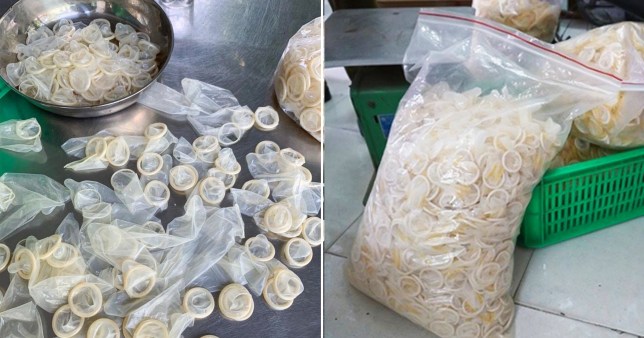
They confiscated all products at the facility, which is located at DX12, Hoa Nhut Quarter, Tan Vinh Hiep Ward, Binh Duong Province, located in southern Vietnam.
Upon their swoop on the illegal production base, all the used condoms were found unpackaged and unlabeled.
Pham Thi Thanh Ngoc, owner of the facility, who comes from Nghe An Province, admitted that she had received a monthly input of used condoms from an unknown person.
The used condoms then underwent a process including washing, drying, and reshaping with a dildo in unhygienic conditions before being put up for sale.
Every year, Vietnamese people use 500-600 million condoms, according to statistics.
Using condoms from dubious manufacturing sources poses a huge threat to human health, including severe infection.
A couple of years ago the Centers For Disease Control And Prevention tweeted out a message aimed at sexually active Americans – advising them not to wash condoms. This is not a joke.
The agency tweeted: “Don’t wash or reuse condoms. We say it, because people do it.”
According to the Daily Mail, as many as three per cent of people have tried to re-use condoms and the CDC want to do their job and help reduce the risk of people contracting sexually transmitted infections (STIs), they also reminded everyone that prophylactics can be picked up for free at health centres and can only be used the one time.
You might think three per cent (3.3 per cent to be precise) isn’t that many people, but there are a lot of people in the US, so that would still equate to a hefty amount of people going for round two with their rubber friend.
To give those people some credit – and the benefit of the doubt – washing condoms used to be standard practice. The Sex Pistols (appropriately enough) and Elvis Costello have even sung songs about washing condoms. But that was back in the ’70s, people.
A couple of years ago the Centers For Disease Control And Prevention tweeted out a message aimed at sexually active Americans – advising them not to wash condoms. This is not a joke.
The agency tweeted: “Don’t wash or reuse condoms. We say it, because people do it.”
According to the Daily Mail, as many as three per cent of people have tried to re-use condoms and the CDC want to do their job and help reduce the risk of people contracting sexually transmitted infections (STIs), they also reminded everyone that prophylactics can be picked up for free at health centres and can only be used the one time.
You might think three per cent (3.3 per cent to be precise) isn’t that many people, but there are a lot of people in the US, so that would still equate to a hefty amount of people going for round two with their rubber friend.
To give those people some credit – and the benefit of the doubt – washing condoms used to be standard practice. The Sex Pistols (appropriately enough) and Elvis Costello have even sung songs about washing condoms. But that was back in the ’70s, people.
A couple of years ago the Centers For Disease Control And Prevention tweeted out a message aimed at sexually active Americans – advising them not to wash condoms. This is not a joke.
The agency tweeted: “Don’t wash or reuse condoms. We say it, because people do it.”
According to the Daily Mail, as many as three per cent of people have tried to re-use condoms and the CDC want to do their job and help reduce the risk of people contracting sexually transmitted infections (STIs), they also reminded everyone that prophylactics can be picked up for free at health centres and can only be used the one time.
You might think three per cent (3.3 per cent to be precise) isn’t that many people, but there are a lot of people in the US, so that would still equate to a hefty amount of people going for round two with their rubber friend.
To give those people some credit – and the benefit of the doubt – washing condoms used to be standard practice. The Sex Pistols (appropriately enough) and Elvis Costello have even sung songs about washing condoms. But that was back in the ’70s, people.
Info News
Best Term Life Insurance Policies for Families
Term life insurance is one of the simplest ways to protect your family financially if something unexpected happens. It provides coverage for a set period, which makes it a practical choice for families who want affordable protection during the years they need it most.
rnMany families choose term life because it can offer a large amount of coverage at a lower monthly cost than permanent life insurance. That is especially useful if you are paying a mortgage, raising children, or trying to replace income for a spouse or partner. The main goal is to make sure your family would have enough support if you were no longer there.
rnWhen comparing policies, focus on coverage amount, term length, and insurer reliability. A policy should be large enough to cover living expenses, debts, childcare, and future costs such as college or mortgage payments. The right term length usually matches your biggest financial responsibilities.
rnIt is also smart to compare riders and policy features. Some policies offer options like accelerated death benefits or conversion privileges, which can add flexibility later. Even though these extras may not matter right away, they can become important as your family’s needs change.
rnHealth and age play a major role in pricing. In many cases, younger and healthier applicants get lower premiums. That is why it often makes sense to buy coverage before health issues appear or before your family’s financial needs increase.
rnA good term life policy should be easy to understand and simple to maintain. You want a plan that gives your family peace of mind without forcing you into complicated features you do not need. For most families, clarity and affordability matter more than anything else.
rnIf you are comparing policies for the first time, think about what your family would need if your income stopped tomorrow. That question can help you choose the right coverage amount and avoid buying too little protection.
rnThe best term life insurance policy is the one that fits your budget today while protecting your family’s future.
rnrn
rn
Mortgage Refinance Guide: Costs, Rates, and Break-Even Math
A lower mortgage rate sounds attractive, but refinancing is not always a guaranteed win. A refinance replaces your current mortgage with a new loan, and that new loan usually comes with closing costs, a new term, new paperwork, and sometimes a reset payoff timeline. The right question is not simply, Can I get a lower rate? The better question is, Will this refinance improve my finances after all costs are included?
The most common reason to refinance is to lower the interest rate. A lower rate can reduce the monthly payment and total interest over time. However, closing costs can include lender fees, appraisal fees, title fees, recording fees, credit report fees, prepaid taxes, prepaid insurance, and points. Some lenders advertise no-closing-cost refinancing, but the costs may be rolled into the loan balance or covered through a higher rate.
The break-even point is one of the most important calculations. Divide the total refinance cost by the monthly savings. If closing costs are $4,000 and the refinance saves $200 per month, the break-even point is 20 months. If you plan to stay in the home longer than that, the refinance may make sense. If you expect to sell or move before then, the savings may never catch up.
Loan term matters. Refinancing from a 30-year mortgage into a new 30-year mortgage can lower the payment but may extend debt far into the future. That can increase total interest even with a lower rate. Some homeowners choose a 15-year or 20-year refinance to pay off the home faster, but the payment may be higher. Others choose a new 30-year term for cash-flow relief. The best choice depends on monthly budget, retirement timeline, and long-term goals.
A cash-out refinance allows a homeowner to borrow more than the current mortgage balance and receive the difference in cash. People use cash-out refinancing for home improvements, debt consolidation, education, or emergency reserves. This can be useful when the numbers work, but it also increases the mortgage balance and puts the home at risk if payments become unaffordable.
Refinancing from an adjustable-rate mortgage to a fixed-rate mortgage can also be smart when payment stability matters. Adjustable rates may start lower but can change later based on the loan terms. A fixed rate can provide predictability, especially for homeowners who plan to stay long term.
Credit score, home equity, income, debt-to-income ratio, property type, and appraisal value can all affect refinance options. A stronger credit profile and more equity may qualify for better rates. If the home value has increased, refinancing may also help remove private mortgage insurance if requirements are met.
Points deserve careful review. Discount points are upfront fees paid to reduce the interest rate. Buying points can make sense if you plan to keep the loan long enough to recover the cost through lower payments. If you may move, sell, or refinance again soon, paying points may not be worthwhile.
Before applying, gather the current mortgage statement, homeowners insurance details, property tax information, income documents, credit information, and an estimate of home value. Ask lenders for loan estimates using the same loan type and term so comparisons are fair.
Questions to ask include: What is the APR? What are total closing costs? Are costs paid upfront or rolled into the loan? What is the new loan balance? What is the break-even point? Are there prepayment penalties? How long will underwriting take? Does the rate lock have a fee? What happens if the appraisal comes in low?
Refinancing can be a powerful financial move when it lowers total costs, improves stability, removes mortgage insurance, shortens the term, or supports a smart cash-flow plan. It can be a mistake when it only lowers the payment by extending debt or adding costs that never pay off. Run the numbers before signing.


