Thursday, November 19

My Voice Was Cloned VP Kembo Mohadi Denies Sexual Misconduct Allegations

Vice President Kembo Mohadi has furiously denied sexual misconduct allegations against him following the release of a series of audios in which he is purportedly asking for sexual favours from his subordinates, who include married women.

At a press conference held on Wednesday, the Vice President said that the allegations levelled against him are false and part of a well-orchestrated plot to demean and soil his image. Mohadi said that the audio clips which are currently circulating on social media are a result of “voice cloning,” and that he is an innocent victim of “political machinations.” Curiously in the same statement, the Vice President said that his private communications have been hacked.

Mohadi also insisted that he is not going to step down from his post as Vice President following a public outcry by some women’s group over his shenanigans. He said that nothing is going to move him and that only President Emmerson Mnangagwa can determine his future.

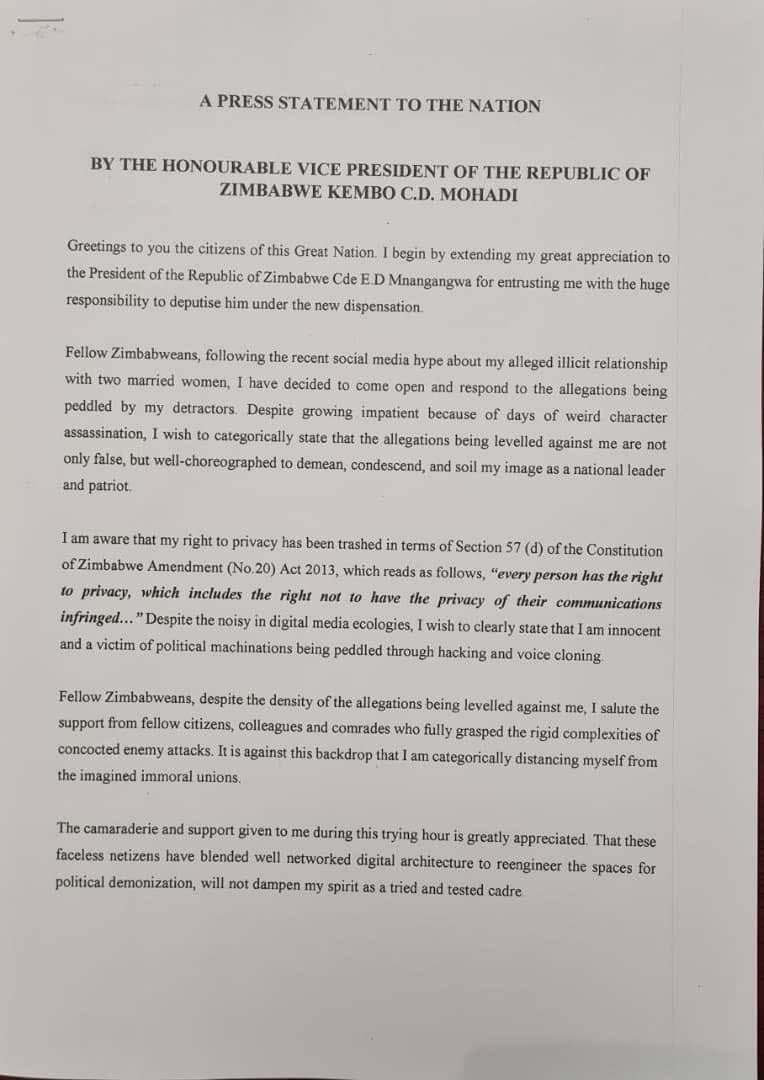
Below is the statement by Vice President Kembo Mohadi denying the allegations which zimbolivenews is publishing in its entirety.

A PRESS STATEMENT TO THE NATION

BY THE HONOURABLE VICE PRESIDENT OF THE REPUBLIC OF ZIMBABWE KEMBO C.D. MOHADI

Greetings to you the citizens of this Great Nation I begin by extending my great appreciation to the President of the Republic of Zimbabwe Cde E D Mnangagwa for entrusting me with the huge responsibility to deputise him under the new dispensation

Fellow Zimbabweans, following the recent social media hype about my alleged illicit relationship with two married women, I have decided to come open and respond to the allegations being peddled by my detractors. Despite growing impatient because of days of weird character assassination, I wish to categorically state that the allegations being levelled against me are not only false, but well-choreographed to demean, condescend, and soil my image as a national leader and patriot.

I am aware that my right to privacy has been trashed in terms of Section 57 (d) of the Constitution of Zimbabwe Amendment (No 20) Act 2013, which reads as follows. “every person has the right to privacy, which includes the right not to have the privacy of their communications infringed…” Despite the noisy (sic) in digital media ecologies, I wish to clearly state that I am innocent and a victim of political machinations being peddled through hacking and voice cloning.

Fellow Zimbabweans, despite the density of the allegations being levelled against me, I salute the support from fellow citizens, colleagues and comrades who fully grasped the rigid complexities of concocted enemy attacks. It is against this backdrop that I am categorically distancing myself from the imagined immoral unions.

The camaraderie and support given to me during this trying hour is greatly appreciated. That these faceless netizens have blended well-networked digital architecture to reengineer the spaces for political demonization, will not dampen my spirit as a tried and tested cadre.

I remain a committed leader, father, cadre and servant of this Great Nation.

I thank you.

Yours Comradely

Kembo C. D Mohadi

  • Share:

Info News

Renewable Energy and the Future of Sustainable Development

Renewable energy has become one of the fastest-growing sectors in the global economy as countries seek sustainable alternatives to fossil fuels. Solar power, wind energy, geothermal systems, and hydroelectric projects are helping reduce environmental pollution while supporting long-term economic growth and energy security.

rnrn

One of the main advantages of renewable energy is that it produces significantly lower greenhouse gas emissions compared to traditional energy sources. Solar panels and wind turbines generate electricity without releasing harmful pollutants into the atmosphere. This helps combat climate change while reducing health risks associated with air pollution.

rnrn

Developing countries are increasingly investing in renewable energy projects to expand electricity access and reduce dependence on imported fuels. In many African nations, solar power systems are helping rural communities gain access to reliable electricity for schools, hospitals, and businesses. Renewable energy industries are also creating employment opportunities in engineering, manufacturing, and construction sectors.

rnrn

Despite its benefits, renewable energy still faces challenges including infrastructure costs, energy storage limitations, and inconsistent weather conditions affecting power generation. However, technological advancements and government incentives continue driving innovation in clean energy systems. Experts believe renewable energy will play a major role in shaping future global economies and environmental sustainability efforts.

rn

How Artificial Intelligence Is Changing Jobs, Business, and Everyday Life Across the World

Artificial Intelligence (AI) is rapidly transforming industries across the globe, creating new opportunities for businesses, workers, and consumers. From healthcare and banking to transportation and online shopping, AI-powered technology is becoming part of everyday life in countries such as the United States, United Kingdom, Canada, Australia, Nigeria, South Africa, Kenya, Ghana, and Zimbabwe. Companies are investing billions into machine learning, automation, and advanced digital systems designed to improve efficiency and customer experiences.

rnrn

One of the biggest areas where AI is making an impact is the workplace. Businesses are using artificial intelligence tools to automate repetitive tasks, analyze data faster, and improve decision-making processes. Customer service chatbots, fraud detection systems, and smart recommendation engines are now common in industries such as banking, e-commerce, and telecommunications. In Africa, startups are increasingly adopting AI technology to improve agriculture, mobile banking, online education, and healthcare access in underserved communities.

rnrn

The healthcare industry has also seen major improvements through AI-powered systems. Hospitals and medical researchers are using artificial intelligence to analyze patient data, assist with disease detection, and improve treatment recommendations. AI is helping doctors diagnose illnesses more accurately while reducing delays in medical services. In countries facing healthcare worker shortages, digital health solutions are helping bridge gaps in medical access and support.

rnrn

Education systems are also evolving with the growth of artificial intelligence. Students can now access personalized learning platforms, language translation tools, and AI tutoring services online. Teachers are using technology to simplify lesson planning and improve student engagement. In developing countries, online learning tools are expanding educational opportunities for young people who previously had limited access to quality resources.

rnrn

Cybersecurity experts believe AI will play a major role in protecting businesses and individuals from online threats. Artificial intelligence systems can detect suspicious activity, monitor networks, and identify cyberattacks faster than traditional security methods. As digital transactions continue growing worldwide, protecting personal information and financial data remains a top priority for businesses and governments alike.

rnrn

Despite its advantages, artificial intelligence also raises concerns about privacy, misinformation, and job displacement. Experts warn that some industries may experience significant workforce changes as automation increases. However, many analysts believe AI will create new careers in software development, cybersecurity, robotics, and digital infrastructure management. Governments and educational institutions are being encouraged to invest in digital skills training to prepare workers for the future economy.

rnrn

Technology leaders predict that artificial intelligence will continue reshaping global economies over the next decade. Businesses that adapt quickly to digital transformation are expected to remain competitive in rapidly changing markets. Consumers are also becoming more dependent on AI-powered applications for entertainment, shopping, communication, and financial services.

rnrn

As artificial intelligence continues expanding across industries, experts believe innovation, regulation, and responsible development will determine how societies benefit from the technology in the years ahead. Countries investing in digital infrastructure, internet access, and technology education are expected to play an important role in the future of the global digital economy.

rn