Marry Mubaiwa, estranged wife to Vice President Constantino Chiwenga has posted on Twitter a picture of the all powerful Vice President admitted at a South African hospital in 2019 in a bid to deny the charges that she wanted to kill him.
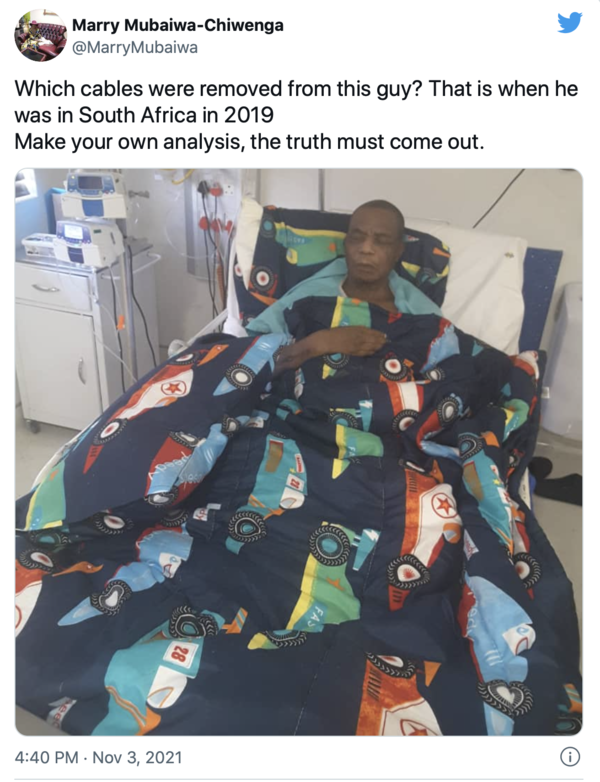
Said Mubaiwa: Which cables were removed from this guy? That is when he was in South Africa in 2019 Make your own analysis, the truth must come out.Prosecutors say Marry Mubaiwa, who denies all charges, tried to unplug Chiwenga's life support tubes in a South African hospital in June last year. She was initially arrested on Dec. 14 on separate charges including fraud and money laundering.
Related Story
Zim vice-president's wife charged for trying to kill him in SA hospital
Mary Mubaiwa, the estranged wife of Zimbabwe’s vice-president Constantino Chiwenga, has been charged with attempted murder of the former military general.
The murder attempt apparently took place when he was in hospital in SA.
Mubaiwa spent the weekend in police custody over graft charges involving about US$1m and forgery of a marriage certificate.
On Monday, she made an initial appearance at the Harare magistrate’s court where her lawyer, Beatrice Mtetwa, told of how Mubaiwa was arrested on Saturday evening while taking a bath at their home in Borrowdale, the richest square mile in Zimbabwe.
The new attempted murder charges surfaced on Monday morning.
According to the state, on June 22 this year Chiwenga was airlifted to Pretoria - but instead of going to hospital, he was booked in and given medicine at the Sheraton Hotel, where he stayed for a day.
It is alleged Mubaiwa was determined for Chiwenga not to go to hospital, but his security detail moved in swiftly and he was admitted at a Netcare hospital the following day.
Chiwenga spent weeks at the medical facility, where he was given an intravenous drip so that fluids, medication and blood products could be administered.
His condition improved, but he was still only able to move around with assistance.
On July 8, it is alleged that around 8pm, Mubaiwa went to the hospital and told her estranged husband’s security to give them privacy. It was then that, according to the state, she “unlawfully removed the medical intravenous giving set as well as the central venus catheter".
It is alleged that Chiwenga started bleeding profusely, and that Mubaiwa tried to kidnap him. She was stopped, but as hospital staff tried to re-insert the intravenous line and the catheter and resuscitate Chiwenga, she allegedly made her escape.
Independent sources told TimesLIVE that this was the last time that Mubaiwa would have access to her husband, who, a few days later, would be airlifted to China where he recovered fully.
Mubaiwa - a former model who also featured in the music video for late reggae artist Lucky Dube's song Put a Little Love - has been remanded in custody until December 30.
Her legal counsel was advised to apply for bail at the high court.
Info News
Stock Market & Wealth Management: Building Long-Term Financial Success
Stock market investing and wealth management services help individuals grow their financial portfolios over time. Investors seek reliable strategies, expert advice, and tools to manage risk and maximize returns.
rnrn
Keywords such as “wealth management services” and “stock market investment strategies” are highly competitive. Content should focus on education, diversification, and long-term planning.
rnrn
SEO-friendly articles that provide actionable insights and market analysis can attract high-intent users. This niche consistently delivers high CPC due to financial services demand.
rn
Tax Law & IRS Debt Relief: Managing Financial Obligations
Tax law and IRS debt relief services help individuals resolve tax issues and reduce financial burdens. Many users search for solutions to manage tax debt and avoid penalties.
rnrn
Keywords such as “IRS debt relief” and “tax attorney near me” are high CPC due to urgency and complexity. Content should explain options like payment plans and legal representation.
rnrn
Providing clear, actionable advice can build trust and improve SEO performance. This niche attracts high-value traffic and strong advertiser competition.
rn


