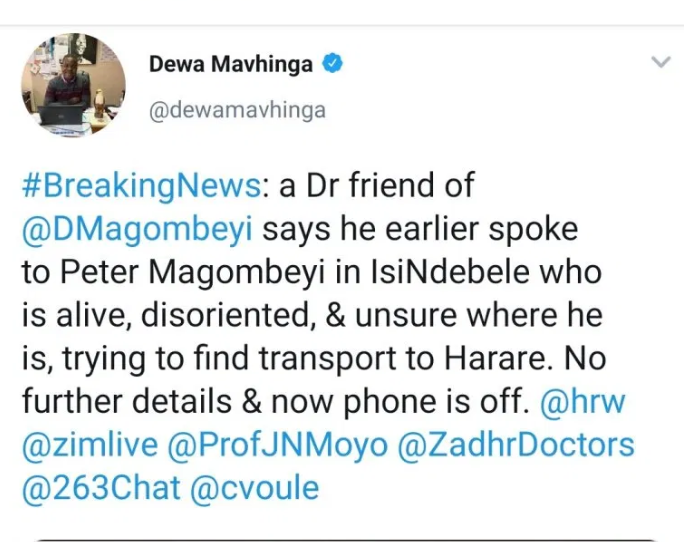
Sources close to Dr Magombeyi have said they have spoken to Dr Magombeyi on the phone earlier today. Some were saying he was in Shurugwi and he was speaking in Ndebele , disoriented and he was not sure where he was and was trying to find transport to Harare.
Read this Twitter Message:
The Last Time Dr Magombeyi was Seen
Missing Harare doctor Peter Magombeyi bade his house-mate farewell and told him to lock up the door since he was going for an all-night prayer, an internal hospital memo has exposed.
According to a Harare Central Hospital internal memorandum dated September 16, 2019 and addressed to the chief executive officer Dr Tinashe Dhobbie by the Human Resources Department, Dr Magombeyi left home intentionally.
“On the 15th of September 2019, we visited Dr Magombeyi’s residence on number 2915 Budiriro 2, Harare. On our way, we passed through Budiriro Police Station where Dr Jena, his house mate was reporting the case. From there went to their house where Dr Jena showed us Dr Magombeyi’s bedroom. On the bed there was laptop and clothes Dr Magombeyi had removed that night,’’ reads the memo.
“Dr Jena told us that the last time he spoke to Dr Magombeyi was the previous night and Dr Magombeyi said that he was going out for an all-night prayer. He also instructed Dr Jena to lock the door since he was not coming back,’’ reads the memo.
Dr Dhobbie last night refused to comment over the phone.
“I haven’t met you and I don’t know you, so I can’t give you the comment,’’ said Dr Dhobhie.
News of Dr Magombeyi’s alleged abduction and disappearance last Friday has been spreading, with opposition and civil society blaming it on State agents.
There has been a series of such abductions lately, which have strongly been suspected to be either staged for publicity purposes or directed by some agents to besmirch the image of Zimbabwean Government ahead of regional and international forums such as Sadc summit and the forthcoming United Nations General Assembly meeting to be held in New York, United States.
Typically, the United States Embassy in Harare, strongly believed to have a hand in “black operations” to justify continued interference in Zimbabwe’s internal affairs, yesterday waded in, accusing Government of being behind the spate of alleged abductions totalling 50 since the beginning of the year.
But details emerged yesterday in a confidential memo released to The Herald that Dr Magombeyi may have left his house in the high density suburb of Budiriro, voluntarily.
The Zimbabwe Republic Police spokesperson Assistant Commissioner Paul Nyathi said they were investigating the case after receiving the complaint.
Speaking to The Herald yesterday, Deputy Chief Secretary to the President and Cabinet in charge of Presidential Communications Mr George Charamba said the recent alleged abductions were choreographed ahead of the President’s United Nations General Assembly meeting and the maiden visit of a UN Special Rapporteur who is due to arrive in the country today. ‘
‘This is a characteristic propaganda stunt by the opposition and its supporters. They are aware that UN Special Rapporteur Clément Nyaletsossi Voule is visiting the country, paying his maiden visit after a long hiatus,” said Mr Charamba.
“As you are aware until now under the First Republic, the Zimbabwe Government would refuse to entertain such a personage.
“The opposition thinks it can draw his attention through such propaganda stunts,” said Mr Charamba
UN Special Rapporteur Clément Nyaletsossi Voule will visit Zimbabwe to assess the country’s achievements and challenges in relation to the exercise of the rights to freedom of peaceful assembly and of association in the country.
This is the first official visit by an independent human rights expert, appointed by the Human Rights Council, to Zimbabwe.
The Special Rapporteur, who is visiting at the invitation of the Government, will meet with Government officials, representatives of the Judiciary, Legislature, independent institutions and civil society.
He will also meet members of the international community including UN officials.
Info News
Business Liability Insurance for Small Businesses
Business Liability Insurance for Small Businesses
Every business faces risk. A customer could slip and fall, a product could cause damage, or a client could claim your service caused financial loss. Business liability insurance helps protect small businesses from costly claims and lawsuits.
The most common type is general liability insurance. It may cover bodily injury, property damage, personal injury, advertising injury, and legal defense costs.
Why Small Businesses Need Coverage
Without small business insurance, one lawsuit could create major financial problems. Even if your business did nothing wrong, legal defense costs can be expensive.
Businesses that rent office space, work with clients, sell products, or operate in public should consider liability coverage.
Types of Commercial Insurance
Commercial insurance may include general liability, professional liability, workers compensation, commercial auto, cyber liability, and property insurance. The right policy depends on your industry and risk level.
Final Thoughts
Business liability insurance is an important part of protecting your company. Before buying a policy, compare business insurance quotes and make sure the coverage matches your operations.
How Artificial Intelligence Is Changing Jobs, Business, and Everyday Life Across the World
Artificial Intelligence (AI) is rapidly transforming industries across the globe, creating new opportunities for businesses, workers, and consumers. From healthcare and banking to transportation and online shopping, AI-powered technology is becoming part of everyday life in countries such as the United States, United Kingdom, Canada, Australia, Nigeria, South Africa, Kenya, Ghana, and Zimbabwe. Companies are investing billions into machine learning, automation, and advanced digital systems designed to improve efficiency and customer experiences.
rnrn
One of the biggest areas where AI is making an impact is the workplace. Businesses are using artificial intelligence tools to automate repetitive tasks, analyze data faster, and improve decision-making processes. Customer service chatbots, fraud detection systems, and smart recommendation engines are now common in industries such as banking, e-commerce, and telecommunications. In Africa, startups are increasingly adopting AI technology to improve agriculture, mobile banking, online education, and healthcare access in underserved communities.
rnrn
The healthcare industry has also seen major improvements through AI-powered systems. Hospitals and medical researchers are using artificial intelligence to analyze patient data, assist with disease detection, and improve treatment recommendations. AI is helping doctors diagnose illnesses more accurately while reducing delays in medical services. In countries facing healthcare worker shortages, digital health solutions are helping bridge gaps in medical access and support.
rnrn
Education systems are also evolving with the growth of artificial intelligence. Students can now access personalized learning platforms, language translation tools, and AI tutoring services online. Teachers are using technology to simplify lesson planning and improve student engagement. In developing countries, online learning tools are expanding educational opportunities for young people who previously had limited access to quality resources.
rnrn
Cybersecurity experts believe AI will play a major role in protecting businesses and individuals from online threats. Artificial intelligence systems can detect suspicious activity, monitor networks, and identify cyberattacks faster than traditional security methods. As digital transactions continue growing worldwide, protecting personal information and financial data remains a top priority for businesses and governments alike.
rnrn
Despite its advantages, artificial intelligence also raises concerns about privacy, misinformation, and job displacement. Experts warn that some industries may experience significant workforce changes as automation increases. However, many analysts believe AI will create new careers in software development, cybersecurity, robotics, and digital infrastructure management. Governments and educational institutions are being encouraged to invest in digital skills training to prepare workers for the future economy.
rnrn
Technology leaders predict that artificial intelligence will continue reshaping global economies over the next decade. Businesses that adapt quickly to digital transformation are expected to remain competitive in rapidly changing markets. Consumers are also becoming more dependent on AI-powered applications for entertainment, shopping, communication, and financial services.
rnrn
As artificial intelligence continues expanding across industries, experts believe innovation, regulation, and responsible development will determine how societies benefit from the technology in the years ahead. Countries investing in digital infrastructure, internet access, and technology education are expected to play an important role in the future of the global digital economy.
rn


