Thursday, August 06

Coach Rambo Hospital Documents Surface as Allegations of a Staged Accident to Target Sir Wicknell For Money

Explosive allegations circulating on social media claim that Zimbabwean fitness personality Coach Rambo, whose real name is Victor Kazembe, and members of his team may have staged or exaggerated a reported accident in an attempt to obtain financial assistance from billionaire businessman Sir Wicknell Chivayo.

The claims have triggered heated debate, with newly shared hospital documents and payment receipts now being presented by different sides as evidence either supporting a genuine medical emergency or raising further questions about how the situation was handled.


However, there is currently no verified evidence proving that the accident was staged, that Coach Rambo committed fraud, or that there was an attempt to extort Sir Wicknell. The allegations remain unconfirmed unless supported by police findings, eyewitness testimony, verified medical records or an official investigation.

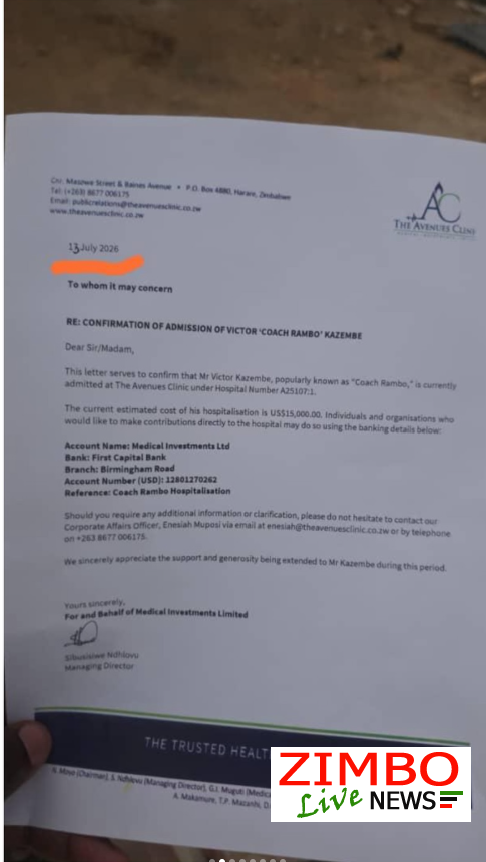
A letter bearing The Avenues Clinic branding and dated 13 July 2026 appears to confirm that Victor “Coach Rambo” Kazembe was admitted to the hospital.

The document states that the estimated cost of his hospitalization was US$15,000 and provides banking details for individuals or organizations wishing to make contributions directly to the hospital.

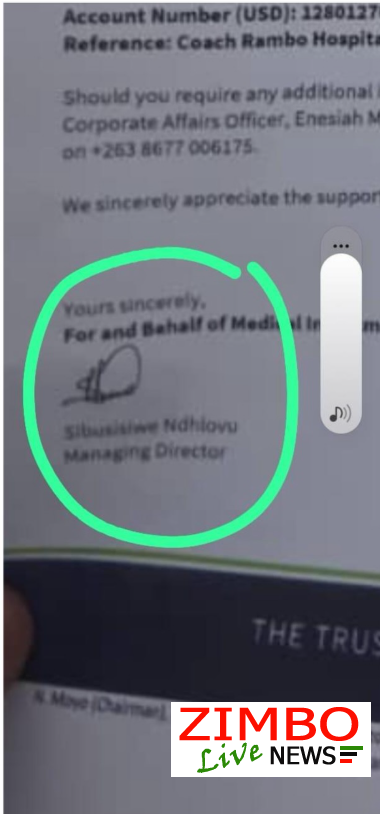
The letter also appears to contain the name and signature of a managing director representing the medical company operating the clinic.

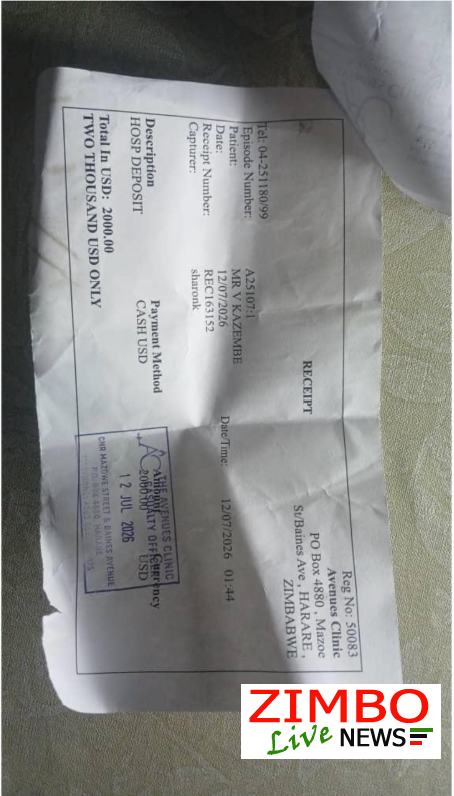
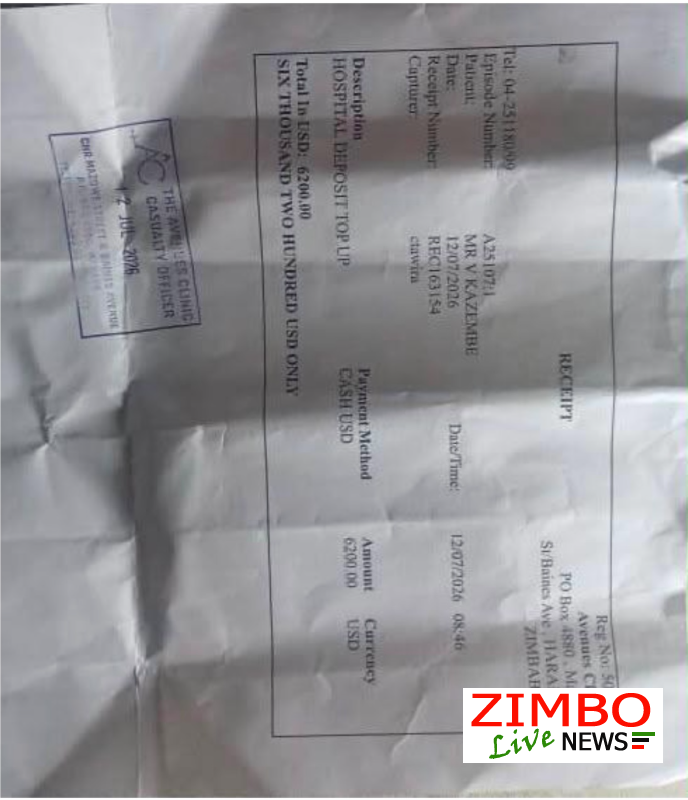
Several receipts bearing The Avenues Clinic name have also surfaced online. They appear to show cash payments made under the name Mr V. Kazembe on 12 July 2026.

One receipt records a payment of US$2,000, described as a hospital deposit.

Another appears to show an additional payment of US$6,200, described as a hospital deposit top-up.

If authentic, the receipts suggest that a total of US$8,200 had already been deposited toward Kazembe’s medical treatment before the admission-confirmation letter was issued the following day.

The documents do not clearly establish who made the payments, where the money came from or whether additional medical costs were still expected.

The circulation of the documents has intensified public debate rather than ending it.

Some social-media users are questioning why a letter estimating hospital expenses at US$15,000 was issued after deposits totaling US$8,200 had apparently already been made.

Others argue that hospitals regularly request several deposits during treatment and that an estimated final bill may be issued even after partial payments have been received.

Questions have also been raised about the reported accident itself.

Critics are demanding to know where the accident happened, whether it was reported to police, who witnessed it, what vehicle was involved and whether an official accident report exists.

Supporters of Coach Rambo say the hospital documents show that he was genuinely receiving medical care and warn against accusing an injured person of staging an accident without credible evidence.

Some online commentators have also closely examined the formatting, signature and wording on the hospital letter, but no qualified forensic document examiner or official hospital representative has publicly declared the document fraudulent.

The controversy comes after Coach Rambo previously received widespread praise for taking part in the recovery of bodies from a sewage-filled pit in Budiriro.

Following that incident, Sir Wicknell reportedly rewarded him with vehicles and financial assistance in recognition of his bravery.

That previous relationship has fueled speculation that Coach Rambo or people around him may have expected the businessman to provide help again following the reported accident.

However, expectation of assistance is not proof of fraud or extortion.

Extortion is a serious criminal allegation that generally requires evidence of threats, coercion, deception or unlawful pressure used to obtain money or property.

The documents currently circulating appear to show a hospital admission and payments toward medical care. They do not independently prove that an accident was staged or that Sir Wicknell was threatened, manipulated or deceived.

There has also been no publicly confirmed police finding stating that Coach Rambo, his team or anyone connected to him committed fraud.

The strongest way to settle the controversy would be through verifiable information, including confirmation from The Avenues Clinic, an official accident report, medical billing records and a clear explanation of who made the deposits.

Coach Rambo, his representatives, The Avenues Clinic and Sir Wicknell should all be given an opportunity to clarify the circumstances surrounding the accident, the hospitalization and the fundraising efforts.

Until such evidence emerges, claims that the accident was staged to extort Sir Wicknell remain allegations and not established facts.

The question now gripping social media is whether the documents confirm a genuine medical emergency or whether further information will reveal a different story.

  • Share:

Info News

Term vs Whole Life Insurance: Compare Costs and Coverage

Life insurance can protect a family from financial hardship if a wage earner, caregiver, or business owner passes away. The challenge is choosing the right type of policy. Two of the most common options are term life insurance and whole life insurance. Both can provide a death benefit, but they work differently, cost differently, and fit different planning goals.

Term life insurance is designed to last for a specific period, such as 10, 20, or 30 years. If the insured person dies during the term and the policy is active, the beneficiary receives the death benefit. If the term ends and the policy is not renewed or converted, coverage ends. Because term life does not usually build cash value, it is often more affordable than permanent life insurance for the same death benefit.

Term life can make sense when the main need is temporary protection. Parents may choose a term that lasts until children are grown, a mortgage is paid down, or college costs are no longer a concern. Business partners may use term life to support a buy-sell agreement during key growth years. A family with a tight budget may choose term insurance because it can provide a larger death benefit for a lower premium.

Whole life insurance is a type of permanent life insurance. It is designed to last for the insured person's lifetime as long as required premiums are paid. Whole life policies can build cash value over time. The cash value may be borrowed against or accessed under certain conditions, but loans and withdrawals can reduce the death benefit and may have tax consequences. Whole life premiums are usually much higher than term life premiums for the same initial death benefit.

Whole life can make sense for people who want lifetime coverage, predictable premiums, estate planning support, or a policy that includes cash value. It may also appeal to people who have already built a strong emergency fund, retirement savings, and basic protection, and who want another long-term planning tool. However, it is not automatically better simply because it lasts longer.

The right choice depends on the purpose of the coverage. If the goal is replacing income while children are young, covering a mortgage, or protecting a spouse during working years, term life may be enough. If the goal is lifetime estate liquidity, legacy planning, or long-term coverage that does not expire, whole life may be worth comparing.

Premiums should be reviewed carefully. A policy is only useful if you can keep it active. Buying an expensive permanent policy and later canceling it can be costly. Before choosing whole life, compare how the same dollars could be used for term coverage, retirement contributions, debt payoff, emergency savings, or other goals. This is not an either-or decision for everyone; some people use term life for large temporary needs and a smaller permanent policy for lifelong needs.

Underwriting is another factor. Insurers may review age, health history, medication, family history, lifestyle, driving record, occupation, hobbies, and sometimes medical exam results. Younger and healthier applicants often qualify for lower premiums, but each company evaluates risk differently. If you have a medical condition, an independent broker may help compare multiple insurers.

When comparing quotes, look beyond the premium. Ask whether the policy is level term or renewable term, whether it can be converted to permanent coverage, how long the premium is guaranteed, whether riders are included, and what happens if payments are missed. For whole life, ask for an in-force illustration, guaranteed values, non-guaranteed assumptions, surrender charges, loan interest, and how dividends are handled if applicable.

Common riders include waiver of premium, accelerated death benefit, child term rider, and guaranteed insurability. Riders can add flexibility, but they can also increase cost. Only add riders that solve a clear need.

Life insurance is not just a product; it is a financial safety plan. Start by estimating how much money your family would need for housing, debt, childcare, education, final expenses, and income replacement. Then compare policy types around that need. A licensed insurance professional or financial planner can help you evaluate options based on your state, budget, tax situation, and family goals.

Globalization and Its Impact on World Economies

Globalization refers to the increasing interconnectedness of countries through trade, technology, communication, and cultural exchange. Advances in transportation, internet technology, and international business have accelerated globalization, allowing goods, services, and information to move more freely across borders.

rnrn

One major advantage of globalization is economic growth. International trade allows countries to access larger markets, attract foreign investment, and create employment opportunities. Businesses can source materials and labor from different countries while consumers benefit from greater product variety and competitive pricing.

rnrn

Technology has played a major role in globalization by enabling instant communication and digital commerce. Companies can operate internationally using cloud computing, online marketing, and global supply chain systems. Social media and streaming platforms have also contributed to cultural exchange and international collaboration.

rnrn

However, globalization also creates challenges such as economic inequality, environmental concerns, and job displacement in certain industries. Some critics argue that multinational corporations may exploit low-cost labor markets while weakening local industries. Trade disputes and economic dependence between nations can also create political tensions.

rnrn

Experts believe globalization will continue shaping international economies and societies in the future. Balancing economic growth, social responsibility, and environmental sustainability remains essential for ensuring globalization benefits people worldwide.

rn